He is waiting to pour forth blessing…
Ash Wednesday is coming soon. Once again, the possibility of a real change of heart will be held before us. A new beginning. A fresh start. This time we might really leave behind some of our old ways so as to receive the gift of being a new creation in Jesus Christ. I wonder what life would be like if that were really to happen.
First, prayer would become more attentive, more focused on the Person I am praying to. This attentiveness is based on the truth that God’s focus is entirely on whomever he gazes upon. He is waiting to pour forth blessing upon all who turn to him—blessings of forgiving enemies, choosing happily the lowest place, cheerfulness in the midst of hardships, suffering with acceptance of same.
Have you noticed that when these are mere ideas or ideals, they soon vanish into the land of well-meaning intentions never carried out? But when the desire for one or the other of these comes from the Lord, it settles upon one’s soul as a gift, a longing that burns to be fulfilled in practice.
Instead of simply saying prayers, the grace of prayer settles on you like a mantle of peace, and, even when somewhat distracted, we are still able to acknowledge that the Lord is near. Our efforts at praying are being taken up into the Lord’s own prayer for us, Jesus begging the Father to grant what we really need.
Second, repentance would become deeper, somehow, like the moment of first conversion, only deeper, wiser, humbler.
At the beginning of the spiritual journey, there is hope that perhaps the Lord will really cleanse me of sin, making me into his new creation. That is a valid wish, but what we probably don’t realize at first is the sobering truth of just how deep our conversion to God has yet to go.
That first moment of conversion—so sincere and heartfelt—is but a glimpse of how one is meant to live at all times. As one of our priests used to love to repeat, “It’s not just that I have sinned, it’s not just that I am prone to sin; it goes so much deeper…I am a sinner.”
That first cry for mercy and pardon is meant to become the song of my whole life, since at any moment I am quite capable of rebelling against my God. In fact, I am prone to do so, and in fact, I often will do so. It is only his grace at any moment that prevents me from doing so.
It is this flash point of awareness that imparts a tenor to the whole season of Lent (and hopefully, beyond). Like prayer spoken of above, these matters are not experienced so much as one’s own insight but rather as a word from the Lord: something like “without me you can do nothing.” This, too, settles on your soul like the dewfall—penetrating yet subtle, all-encompassing yet comforting.
There is another gift the Lord wants to accomplish within us, but its form is entirely personal to each one of us. Lent is a time when the Lord may bring us face to face with something or other that we least want to look at or experience.
Is it a fault within ourselves that until now we have simply found too difficult or too painful to address? Is it the acceptance of circumstances in our life that we wish would change but that show no signs of doing so? Is it fear about the future when the Lord is asking us to trust him? Is it a rebellion of no small measure at the thought of any of the above?
A situation that I am dealing with includes a number of those questions. It has to do with the developments of Parkinson’s disease.
I’ve written from time to time in this column about various aspects of living with this illness. And I’ve been determined not to turn this column into an ongoing health report by yours truly.
From time to time, however, I like to share with you, our readers, something of what I’m dealing with on this level. It may be of help to other people struggling to deal with health or other challenging issues in their own lives. At least, that’s my hope.
Parkinson’s involves a number of issues, one of the most important being mobility. As the disease develops, one’s mobility generally decreases. This doesn’t happen overnight, but over the course of years, mobility becomes more of an issue, necessitating eventually the use of a walker or cane or some other support.
Over time even this stage is surpassed, and one is forced to resort to a wheelchair of one kind or another. I haven’t reached this point yet, but at times it can feel like it is getting uncomfortably closer.
A person never fully realizes how much something is valued until it is taken away. In that sense, however, it is no different from any other stripping, spiritually speaking, that the Lord knows we must undergo if we are to really depend utterly on him.
Of course, no physical debilitation can guarantee spiritual transformation! But the physical has a great influence on our spiritual lives, as we all know.
I’m not one who believes there are easy answers to difficult dilemmas. Especially difficult dilemmas in the spiritual life, which is so personal to each one of us. But somewhere along the line, whatever our degree of faith or trust in God, we reach our limit, and, in many cases, we less tranquil souls have to pass through fear or rebellion or anger or bewilderment before we come to peace with God and with ourselves.
It is that deeper peace that we all long for, and it is the risen Lord who alone can breathe it upon us. Our part is to do whatever the Lord inspires us to do so that we are disposed to receive that peace.
What does that include? Prayer and repentance leading to surrender to the Lord, as mentioned above. But also almsgiving, where we catch a glimpse of his face in those who are in need. And finally, in fasting, where instead of imbibing this or that, we hold a space open within ourselves that cries out to the Lord to minister to our brothers and sisters who suffer.
Any suffering we undergo is also part of that cry, until the luminous night that is Lent gives way to the brightness of Easter and the Lord’s cry of victory for us and in us.
He who is compassion carries enough mercy to heal a whole world of its wounds. Let us turn to him in confidence!
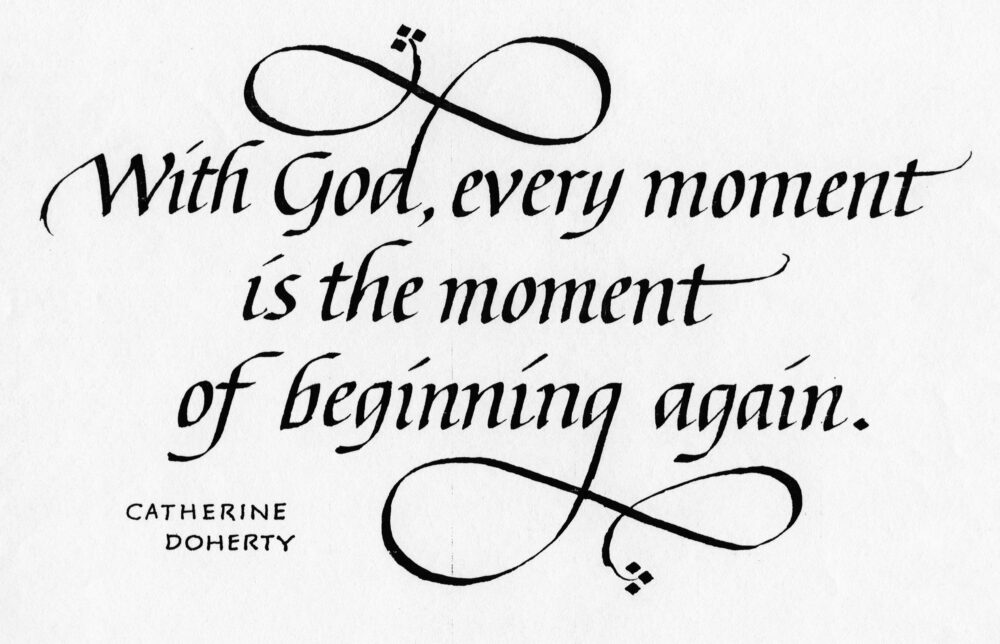
[Calligraphy by Fr. Eric Lies]