We do “apostolic farming”
Farming today may be business, even big business, but those who forget that farming is a way of life will someday weep over their forgetfulness. For there is no better place to live the Gospel than on a farm. Nowhere do men and women come closer to God than in the country, in rural areas, and nowhere are they closer to him than when they till the earth and look after the flocks
Jesus was born in the countryside, and he lived in the countryside most of his lifetime. He wasn’t a farmer, but the Gospel is filled with examples from agriculture. He talked about vineyards, crops, plowing, grains, and seeds. He loved to use parables about sheep. In his voice was tenderness towards the earth and all growing things.
Do we have that tenderness? Do we have that love? Have we that understanding?
When I was a little girl in Russia, we had shepherds and shepherdesses for our cows, horses, and sheep. They knew the serenity and peace that comes from living a life of silence and being one with nature and the God of nature. All were deeply religious, and the villagers considered even the young ones wise. They were respected, and they loved their work.
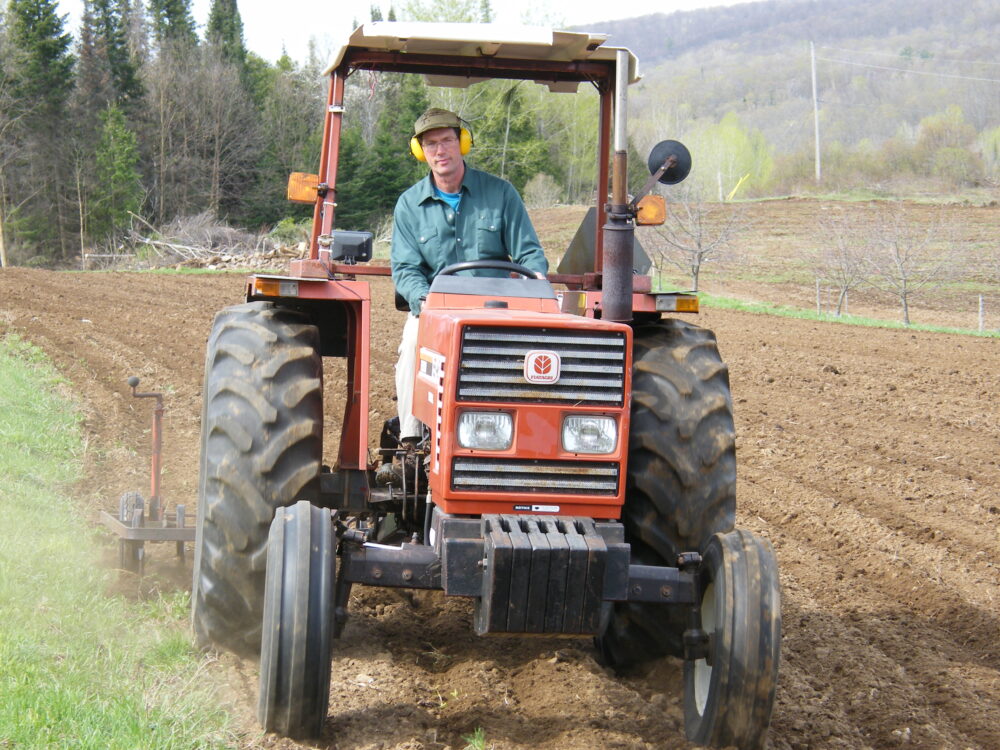
At Madonna House we have a farm called St. Benedict’s Acres. There we do what I call “apostolic farming.” Our farmers seek to make the farm as productive as possible by using the simplest means possible, and as little money as possible, to feed our brothers and sisters so that the money that is saved might go to those who are in need.
We talk to God and our Blessed Mother and to St. Isidore, the patron of farmers, all of whom were able to do so much with so little. Just as in everything else, in apostolic farming, every action has an eternal value.
A farmer doesn’t have “chores” to do. The word “chores” implies heaviness, unpleasantness. No, a farmer saves the whole world by feeding the pigs! Spreading manure has the same value as writing a thesis or working at any occupation that might appear to be cleaner.
And there is nothing dirty about farming! Everything the farmer deals with is clean, and everything has a purpose. The manure is going to give us food for next year. The hog will be eaten. The cow will produce calves and give milk and meat. Everything on the farm leads to the feeding of humanity. How can it be dirty when it feeds our bodies that are temples of God, where Christ comes to dwell?
Apostolic farming demands the whole of a person. It is the best way to die to self because nature and animals are there to remind one, better than any monastery bell, of the duty of the moment. Always before the eyes of the apostolic farmer is the connection between his daily work and the feeding of his brothers and sisters.
Time belongs to God and it is precious. The apostolic farmer knows the value of time and reveres it. If he misses a day, there may be no hay. If he plows a little too late, there may be no harvest. If he seeds one hour too late, and a storm comes, then all the work will be undone.
Farmers know that time is a part of eternity, which God has given them in order that they may grow in love and become saints, which is the call of every Christian.
Apostolic farming is a slow process, and it teaches farmers lessons not learned in spiritual books. It strips them naked of many preconceived notions and makes them whole again. Farmers who work with the earth, from which they came and to which they will return, are healed of their wounds. In a mysterious way, a farmer, reconciled with God, walks with him at eventide while they both look over the work of their hands.
In the world, there are two people who really touch God. The priest touches God in his very essence, and the farmer touches God in his creation as it came from his hands.
In Russia, the word for peasant is krestianin, which is almost the same as khristianin, “Christian.” The Russians have the right idea—a farmer should be the epitome of a Christian.
Adapted from Apostolic Farming, available from Madonna House Publications
[Photo of Madonna House farmer Scott Eagan, by Noel Sylvain]