Are we ready to die to self?
I have been thinking of the pain of Christ. Perhaps because Lent is approaching, my mind turns quite naturally to his Passion. And it brings with it the realization that this same passion continues daily in his Mystical Body, the Church. And this means in us!
Yes, in you and me, and in every living human being. The question arises in my heart: how are we, children of his Sacred Heart and of the Immaculate Heart of his Mother, we who have been so specially called to the twofold fruit of that Passion — how are we to bear it or share it in our own minds, bodies, hearts, and souls? For this sharing is its first fruit.
The second one is to assuage his pain in others. To share the Passion of Christ! To be ready to bear its marks — deep, searing, consuming. Are we ready?
Exultant Joy
Are we ready to die to self, to so forget ourselves that we feel a joy in being wounded as he has been wounded, in being counted as nothing as he has been counted nothing, in being unjustly accused as he has been unjustly accused?
Are we ready to be persecuted as he has been persecuted— by the thoughtlessness of our own, by the difficulty of their personalities which rub into the wounds of our minds and hearts, even as the dust of the Via Crucis rubbed into his; by the misunderstanding of those we look up to; by the crown of thorns that responsibility forms around our head? It is as heavy as any crown can be at times.
Are we ready to spend our nights with him in Gethsemane sweating, if not blood, then tears, shed or unshed? Are we ready to go with him into the desert for 40 days to be tempted as he has been tempted?
Austere Vocation
Yes, that is what sharing Christ’s passion means: accepting to be nailed to the cross of our austere, glorious vocation, even unto being pierced with the sharp nails of days and nights spent for others without a thought for one’s own comfort, consolation, needs, desires, or dreams.
Yes, I repeat, crucified by the nails of everydayness, of a routine so familiar as to be excruciatingly painful at times.
Unless this is done, unless we really steep ourselves in Christ’s passion, identifying ourselves with it lovingly, joyously, wholeheartedly, we cannot implement its second fruit. We cannot go forth into the byways and alleyways of the world to seek out the suffering Christ in our brothers and sisters.
For we will not understand his pain. And without understanding, there is no love. And without love, there is no healing, no assuaging, no making whole.
I have been thinking of these things before his face in the Blessed Sacrament, in the quiet hours of the night when sleep would not come to my tired eyes. I think of them in the few spare moments of a busy life, for before my eyes the sight of his pain in our brethren is forever present.
At times it seems to me that I have been bled white by the wounds that this sight inflicts upon my soul, heart, and mind. It even makes me feel that I will not be able to get up in the morning. The pain of Christ has bowed me down and made me weak, and it seems that all my bones are broken. But by his grace and by it alone, I get up again, for I must. Otherwise, I will not share his pain while asking you to do so.
There are nights in my life when I feel as if I am drowning in the sea of Christ’s sorrow and that of Mary. Sometimes it seems I can feel and see, even as Mary of Magdala has. Have you ever thought what it must have been for her and for St. John the Beloved to watch all this?
Sometime, when all is quiet and the night has hushed a long day, go into the chapel and make a meditation. You are Mary of Magdala. You love Jesus passionately. You are always there, where he is. You know everyone around him — the Pharisees, the Sadducees, the rich people of Jerusalem and Palestine, the middle class, the ordinary folks. As anyone would who is close to a leader, you begin to see the gathering storm.
But you are not God, though you know that he is. Try to imagine what it feltlike, to be Mary of Magdala, and see hate rise, and watch his mother Mary suffer. To watch, hear, and see … and to be unable to do a thing about it except to love more, suffer more, pray more, keep closer, ever closer to him who seems bent on entering that very storm of hate.
Or try to be John the Beloved and watch the same thing that Mary saw — only with a man’s mind, an immense mind at that, and a heart that loved so much that it remained steadfast to the end.
Try to think of yourself at the Last Supper. Your head is resting on his breast. Steady and strong, the heart of God beats in your ear. What happens to a man who hears the heartbeats of God? Stay in the chapel a while longer and think, trying to imagine the sound of that heartbeat. It was the source of all the music in the world, for it was the source of Love!
And then both of those loving hearts — ordinary human creatures compared with Jesus — saw their loved one crucified and before that, whipped, spat upon, made to carry the cross, the gibbet of shame; saw him fall and, 1 repeat, saw him hang like a common criminal between heaven and earth.
Now is the time to compare our faith with theirs. Now is the time to compare our love with theirs. Now is the time to assess our sharing, our bearing— or perhaps I should even say our entering into the passion of Christ.
Key Questions
Perhaps another evening or many more will be needed for that comparison. Do we love like they did? Do we believe as they did? Do we identify, share, bear his Passion as they did?
I am not mentioning Mary, his mother, for I think that first, perhaps, we who have barely learned to walk in the way of Christ’s passion should take St. John and St. Mary of Magdala as patrons this Lent. Ask them, who were so close to Mary, to lead us slowly to her.
Maybe next year or the year after, we might, on our knees, approach the suffering of Mary and ask her to take us into that final novitiate that will, I know, reveal to all those who enter it the real secrets of God’s love … for it will reveal the secret of his pain.
Editor’s note – This was a Lenten meditation from 1957.
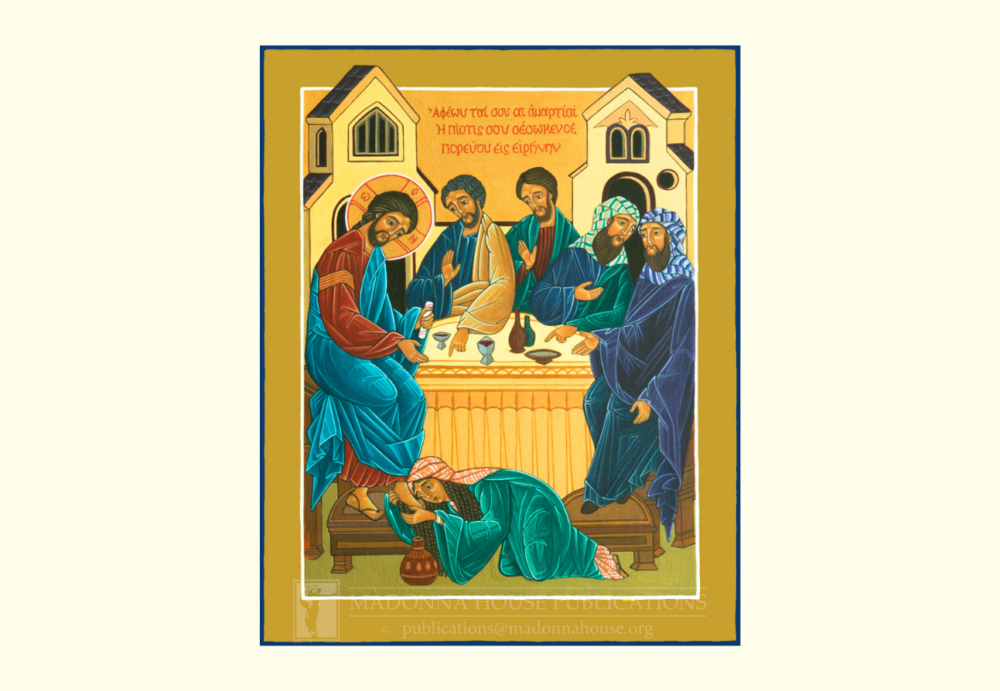
[image: Mary Magdalene washes the feet of Jesus icon by ©Helen Hodson, Madonna House.]