We are saved sinners.
Christ told us that his joy can and should be our joy: So you have sorrow now, but I will see you again and your hearts will rejoice, and no one will take your joy from you. In that time you will ask anything of me. Truly, truly, I say to you, if you ask anything of the Father, he will give it to you in my name. Hitherto you have asked nothing in my name; ask and you will receive, that your joy may be full (Jn 16: 22-24).
The Christian knows tribulation, sorrows, suffering, frustration. Like all his brothers and sisters in this world, he is often misunderstood, judged, and condemned. People near him, people he loves dearly, may be discourteous, for instance, without even being aware of it.
His greatest suffering, I believe, is gradually to become aware both of the ideal presented to him by the Gospels and how far he is from attaining this ideal.
He experiences within himself — in spite of prayer, penance, good works— arrogance, lust, greed in all its forms. In other words, he is human. He is very imperfect. But at the same time, he has joy in the very core of his being, in the very midst of the tribulations which may come from inside and outside. Perfect joy doesn’t mean absence of pain, temptation, or doubt.
◈◈◈
The Gift of Joy
In recent years I have experienced within my own heart, periodically, what I believe to be the joy of the Lord. It is a gift not due to my good works but to his forgiveness, to his gentle mercy, to my faith in his presence in my heart. For me, joy has come to mean an awareness that I am beloved by God always.
If I suffer a misunderstanding, rejection, or persecution, the glorious fact of his presence within me —when I advert to it (often after about of self-pity), heals the wound and changes the pain into joy.
Like many members of my generation, I was brought up a Jansenist. I felt in my very bones that God could love me only if I became beautiful in his sight by my own efforts, thus denying my need for the mercy of God, thus denying (without meaning to) the passion, death and resurrection of the Lord Jesus.
For God and people to love me, to appreciate me, to accept me, I had to be strong, I had to be perfect. I expected the same perfection from others, especially those closest to me. This false inner attitude caused me much suffering. Every sin I committed produced an unnecessary amount of shame and guilt.
Joy entered my heart when I realized that I was a saved sinner . . . in a continuous process of salvation . . . that I could not count on my own efforts to save myself but that I could always count on the mercy of God to forgive me immediately as soon as I said “I’m sorry,” as soon as I acknowledged my sin to the Church through the priest, kneeling at his feet to receive absolution and to experience once again the awesome mercy of our God.
◈◈◈
Inner Change
Gradually I came to accept the fact that I had been saved by the Lord Jesus, made into a glorious creation, given a great faith, hope, and love in Baptism, at every Eucharist, by every absolution. I came to know also that I needed the help of God to avoid serious sin just for today. I started praying more and more for perseverance. . . the grace of being loyal to faith, loyal to hope, loyal to love today, more loving towards God, more open to his immense love.
When I sin, God wants me to be honest and truthful, to say “I have sinned, I’m sorry, Father; have mercy on me, Jesus; Holy Spirit, give me hope. “Slowly God lifted from my heart and spirit the immense burden of shame and guilt which Jansenism had piled up over the years. My joy is the love of my God for his beloved son, myself.
The sacrament of Penance has caused much suffering to many of us. A very holy, elderly woman — truly a beautiful person dear to God and practically sinless — once said to me: “Confession is the most awful thing in the world.”
No wonder so many people have ceased to seek the mercy of God in the sacrament of Penance, which is meant to be a moment of love, a moment of tenderness, a moment when one experiences the embrace of the wounded Christ now glorified, powerful, healing, and comforting each one who comes to him.
We are saved sinners, alleluia, alleluia, alleluia. God has fallen in love with us. He invites us humbly, modestly, quietly, to fall in love with him . . . “You shall love the Lord your God with your whole heart, your whole soul, your whole might; and your neighbor as yourself.”
I can refuse to love today. I have the power to close my heart to him, to be unforgiving, to judge my brother, to be intolerant with his weaknesses. In other words, I can sin, I can walk away from the path of love and of life. Each day I am faced with a free choice: to live or to die; to love or not to love. Therefore, pray with me for perseverance . . . that today I will choose love and not death.
◈◈◈
Solution
We are saved sinners. Alleluia! Anyone of us who thinks that he’s got it made, that he’s got it all together, that he is safe from sin, will soon fall flat on his face. But he can pick himself up right away, turn to his Father and say very simply: “I’m sorry. I forgot about you. I have been self-sufficient. I thought I could do it all myself. Please forgive me.”
He can spend the rest of his day praising God for his mercy. He becomes a living sacrifice of praise.
There have been brief moments in my life when I thought I had it all together. Gradually the Holy Spirit took away all my strengths and began to reveal my sinfulness and weakness. It was a despairing time for me because of my Jansenism. It has now become a great joy. I know many of my weaknesses, I know that I am very far from being perfect and self-sufficient. I know that I need the help, love and mercy of God, of my brothers and sisters. That is joy.
There have been times when I hardly believed in God, when I doubted immortality — life after death — the presence and interest of God in many of us, when I doubted the Resurrection of the Lord, when I felt that life had little or no meaning, that it was all a bad mistake.
In those most tragic moments for a priest or any believer, I simply kept saying over and over again the name of Jesus, and it eventually saved me from despair and error and illusion and temptation. The little humble prayer “Mary, Mother of God, save us” has also often saved me.
◈◈◈
Truly Human
A person is truly human who loves and who needs love. A person is truly mature who seeks for help when needed, and who gives help to those who need it.
The family of Christ is not made up of self-sufficient supermen and women who have got it all together, but of little children who hold hands as they cross a little river, who help each other climb a little hill, who share their food with one another, who play and dance together. They can play and dance because they know they have a Father, a Lover, a Comforter . . . and the most tender of Mothers.
Bring joy to someone today. Be gentle in your speech. Be careful of words you use to reprimand another, to correct a brother or sister. Be courteous. We need each other so much. We need to see love and respect in each other’s eyes. It is that kind of love which gives life to another person.
Should there be pain in your heart, should there be anger, spill it out to someone who will receive it tenderly and heal the wound by his or her peace. A great saint has said: “Acquire interior peace and a multitude will be healed near you.”
My great desire now is to experience the perfect joy of St. Francis, the joy that comes from turning the other cheek, from loving one’s enemies, from bearing insults and humiliations. What a freedom that joy brings in its wake! How very happy the person who can rejoice at being rejected, for that person walks hand in hand with the greatest love of them all — the humiliated Christ. I pray for this miracle. With the love of your prayers, I firmly believe that God will grant it to me.
May your joy be full today!
Fr. Brière (RIP June, 2003) was one of the pioneers of Madonna House, and a close friend of our foundress Catherine.
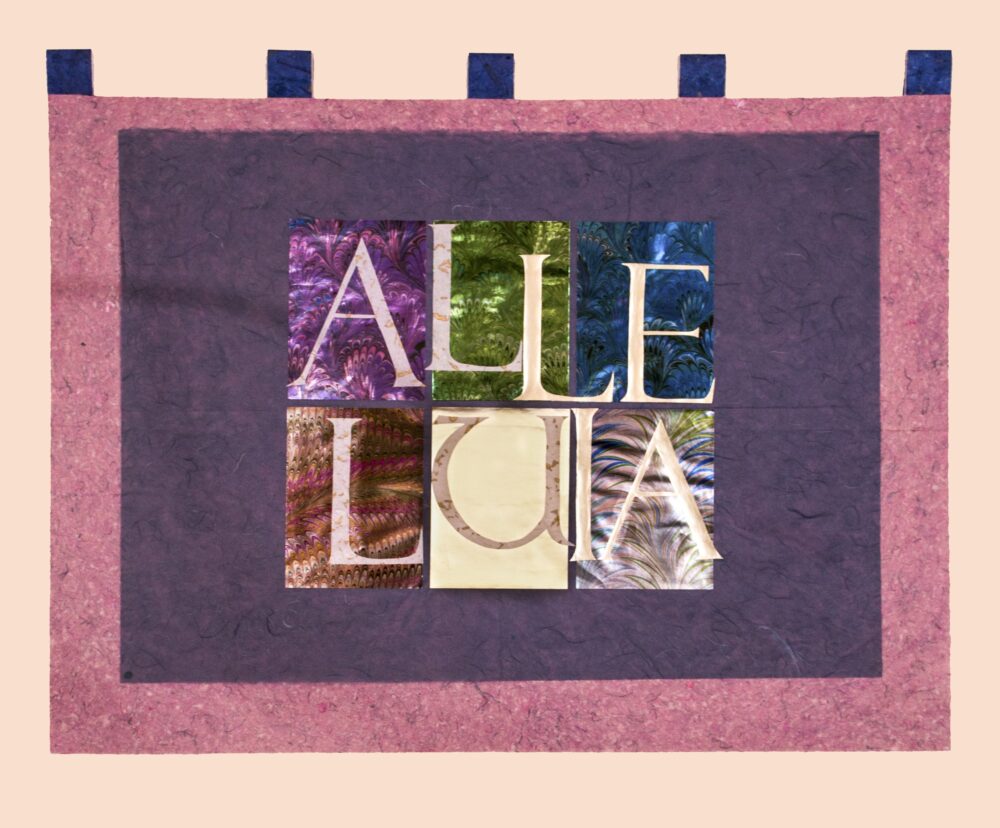
[image: Alleluia banner by ©Pat Probst, Madonna House.]