Xenia’s suffering is where she encounters God
I first met Xenia (or Zenia) in the Ontario backwoods, halfway through Lent. Sap buckets hung from the maple trees, and our footsteps from yesterday were frozen at the edge of the road. I was walking in silence with a friend, our conversation having come to a lull, when she started talking about this strange saint.
She said that Xenia had lost her child and husband in close succession. Comfortless, she gave away her possessions until all that remained were her late husband’s army coat and her grief. She wandered the streets of St. Petersburg wearing that coat to rags, relying on the alms of strangers yet accepting very little; anything given to her seemed to fall through her hands and into the hands of the poor around her.
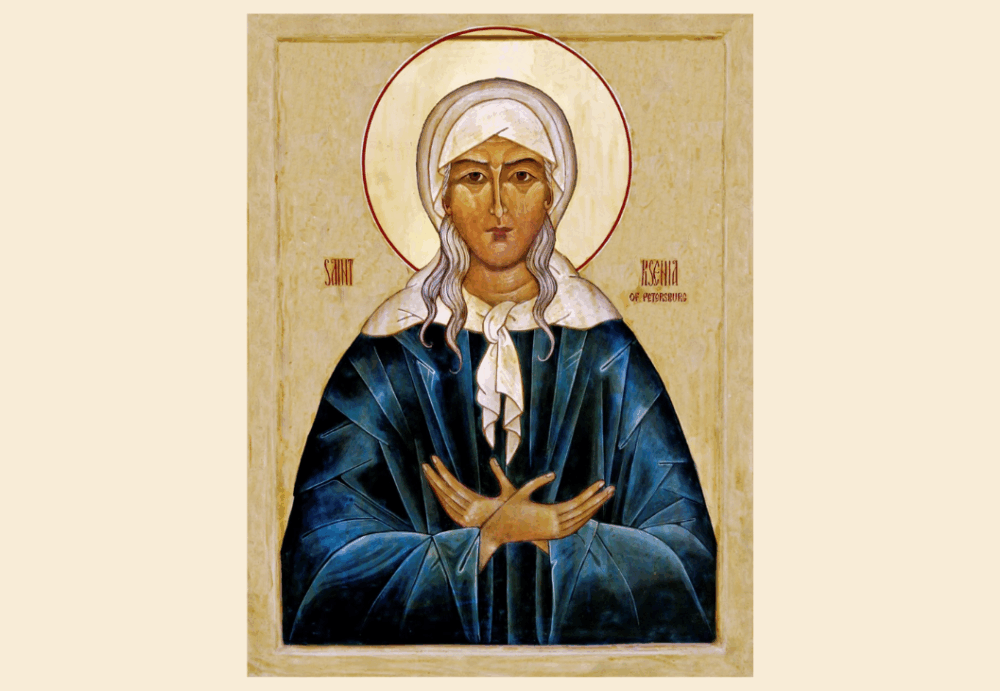
“There’s an icon of her in our chapel,” my friend said. Next time I was at Mass, I looked for her but couldn’t find her. It turned out that her icon had been on the wall against which I usually sat, so near to me that I couldn’t see her.
Xenia is the patron saint of those with mental illness. She is counted among the Urodivye, the fools for Christ. In Russian spiritual tradition, these figures feign insanity to draw attention to the true fools — those who stake their identity and security in the world, rather than in God.
To what extent Xenia’s extreme dispossession and preference for homelessness was a result of feigned insanity, it’s hard to say, but certainly her mental distress was not an act. In fact, her physical separation from the life she knew points to a deeper reality — that there is a particular loneliness that accompanies mental suffering, and it often remains invisible.
As seems to be the case with many Urodivye, the figure of Xenia has taken on a mythic quality. Even during her life, she became known as “the Blessed One” among those who recognized her on the streets of St. Petersburg. It was considered good luck if she entered your home or kissed your child, and it was said that she had the gift of clairvoyance.
When my friend first told me about her, I was perplexed. Something about her fascinated me, but my Western mind couldn’t reconcile the few details we know about her life with what I understood holiness to be.
Perhaps it is precisely this strangeness that has captured the imagination of artists and writers who have taken her as inspiration. In these depictions a deeper truth is revealed, not just about Xenia’s life, but about the nature of suffering and about God.
A year and a half after Xenia and I met, my life took a complete U-turn. I’m not a stranger to mental and emotional suffering, but the circumstances in which I found myself left me with a depth of desolation that I hadn’t touched for a long time. I knew the threadbare ideas I had about myself, God, and holiness would not be able to withstand it.
While everyone else in my life seemed to go on existing as if their ideals could stand the test of time, I watched my own crumble.
Cue Xenia. She re-entered my life, through some algorithmic fluke, in the form of artwork on my Pinterest feed. Russian artist Alexander Prostev has created more than fifty drawings and paintings of Xenia’s life, beginning with her happy marriage and through to her death.
There is a hush-like quality to these paintings: Xenia drifting through the streets of St. Petersburg, Xenia bent against the wind while an angel shelters her under its wing, Xenia with her face lifted towards the sunlight. Her suffering is visible in the contours of her face, yet so is her peace; her loneliness is revealed through a subtle glow that encases her.
Perhaps it is this contradiction — suffering and peace, loneliness and glow — that attracted me to these paintings. All I knew at the time was that they depicted something I understood on a deeper level than that of words and logic.
Recently, Xenia reappeared in Debra Dean’s novel, The Mirrored World, bringing this contradiction into clearer view. Dean’s narrator, Xenia’s cousin and closest friend, holds the mythic aspect of Xenia’s life in tension with the depth of her suffering. She watches helplessly as Xenia’s mind shatters under the weight of her grief, observing, “It was only her profound sorrow that made her a foreigner amongst us now.”
Xenia’s experience of deep grief alienates her from the human relationships she once cherished; the ideas she had formed about life cannot withstand her sorrow. Xenia’s cousin can’t reach her in her suffering, and Xenia can’t find her way out.
Dean’s narrator outlives Xenia, and after Xenia’s death, she reflects: “Perhaps the saints are right in thinking that the depth of one’s love is measured by the capacity for suffering, yet one cannot help but question those who court it with such fervour. Even Christ, who submitted willingly to his suffering, first prayed that the cup might be taken from him.”
We don’t know. Perhaps Xenia did pray along with Christ, “Father, if you are willing, take this cup from me,” but in the same breath, Christ adds, “yet, not my will but yours be done” (Lk 22:42).
This verse from Luke is followed by “Then an angel from heaven appeared to him and gave him strength” (22:43).
In Prostev’s paintings there is a recurring character: an angel that guides Xenia through crowded streets, ties the laces of her tattered boots, bends over her as she sleeps on a bench, and collects her soul at the end of her life.
Prostev’s angel suggests that Xenia’s suffering is where she encounters God. I have not suffered as deeply as Xenia has, but even I know that, in reality, God’s presence is often not as tangible as an angel-guide. But I believe that when we pray, with Dean’s imagined Xenia and with Christ, “Let this cup pass… not my will but yours be done,” we are making an act of faith: if God doesn’t relieve our suffering, it is because he is in the midst of it.
When my ideas about the world came tumbling down in the face of immense change, I felt helpless before my inability to communicate what I was experiencing.
At a certain point, the image of an anchorage came to mind, a tiny stone cell in the wall of a church, where an anchoress would live out her life in solitude and seclusion. In many respects, she would be cut off from the world, dwelling in what must have been a lonely, humid, tomb-like space.
But it is in this very place that she would encounter the invisible God and where he had called her to encounter him. I couldn’t seem to break the stony surface of my sadness by my own strength, but I felt a call to wait it out with the expectation that if God hadn’t shown me an exit, it was because he desired to encounter me here, in the anchorage of my bruised heart and mind.
Once I was able to respond to the invitation to submit to my suffering (rather than thrashing against the stone walls like a trapped bird), I was able to notice God patiently waiting for me.
I remembered that to be in God’s presence was all I had ever wanted, anyway. We rested there, in the dark, for a little while. Then, slowly, he began leading me from sadness back to joy.
I don’t know what inspired my friend to tell me about Xenia when she did, but it has been a comfort to have her friendship in this season of God and I journeying into unknown territory. Whether Xenia’s total dispossession and life of wandering is a true sign of holiness is not for me to decide. The reality is that in the midst of her suffering, God found her, and she let herself be found by him.
So, for those who are suffering, let us pray: Take this suffering from me, Lord. And if you will not, let me find you dwelling with me in the midst of it.
Icon by ©Marysia Kowalchyk, Madonna House.