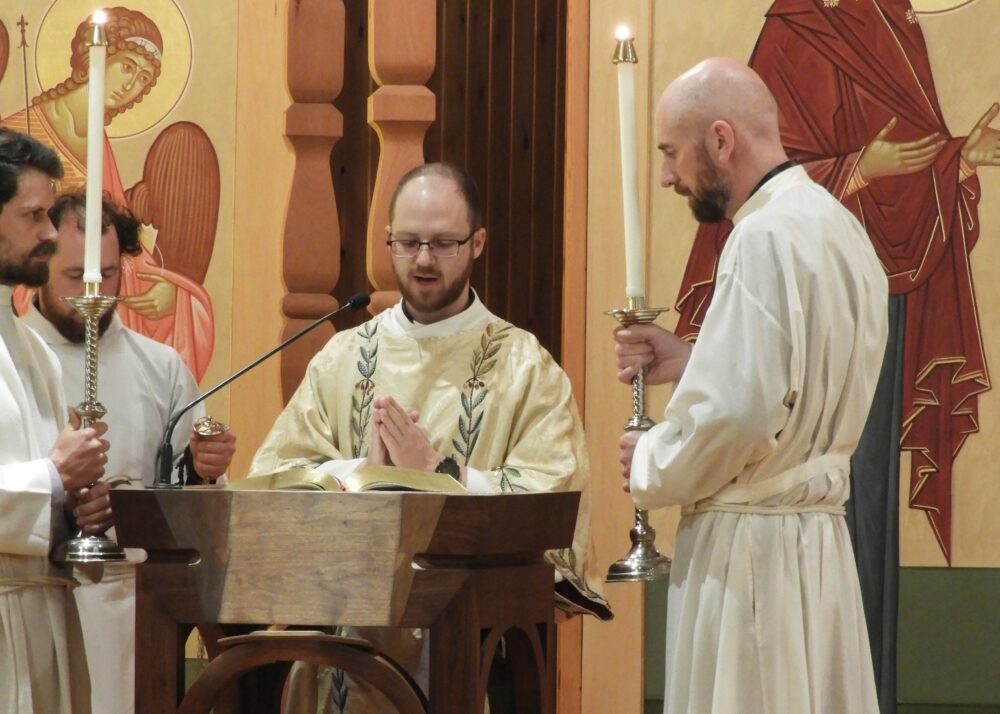
This is the second of three articles on the basic structure of the Sunday Mass in the Roman rite.
◈◈◈
Part I of this talk was an introduction to the basic theology of liturgy as a structured way of prayer which invites us to come out of our own personal prayer and our own individual spiritual journey and to enter the prayer of Christ mediated through the common prayer of the Church.
This movement from our own interior conversation with God into the larger world of Christ and the Church, is actually the whole purpose of our personal spiritual life: the transformation from the “I” of the self to the “we” of the Church, which is itself in the process of being transfigured into the great “I am” who is Christ our Lord.
In the liturgy, we are drawn out from the shallows into the depths of God and the spiritual life, even if, and maybe especially if, the felt experience we have being at Mass is not like that at all.
◈◈◈
Now we are beginning the Liturgy of the Word. We can think of many Gospel parallels to how the Liturgy of the Word comes before the Liturgy of the Eucharist. Jesus explains the scriptures to the two disciples on the road to Emmaus before he makes himself known in the breaking of the bread. He taught the crowds at length and then fed them with the miracle of the multiplied loaves.
We can think of Our Lady first hearing the word through the proclamation of the angel and then, after consenting to it in faith, bringing forth Christ in the flesh from her virginal womb. All of that parallels the deep spiritual meaning of the Liturgy of the Word in the Eucharist.
This part of the Mass also highlights for us the centrality of faith in our entry into the divine action. God reveals himself to us in word and in proclamation, and we are invited to give him our consent, ultimately by praying together the Creed. This act of faith, which itself is a graced, God-empowered act, is our free entry into what follows: the Lord’s gift of divine life in the liturgy.
The first reading is from the Old Testament, inspired scripture written by God and by its human authors. The Church from the very beginning has had to defend the inspired, divine nature of the Jewish Scriptures.
Admittedly, the Old Testament is not easy to understand. It can seem quite puzzling and remote from us, like a voice from a far-off place. Much historical and textual context is needed. It is the revelation of God, B.C., before Christ; the imperfect, not-fully-understood revelation, the light of God shining into human darkness.
Quite often in the Old Testament, the light and the darkness mingle together in ways that are hard to disentangle, but the light gradually grows brighter as the coming of Christ draws nearer.
As we grapple with the Old Testament, we are called to reflect on our own mingling of light and darkness, our own less-than-perfect understanding, our own less-than-clear reception, our own less-than-ideal living out the fullness of the Lord’s revelation, our own reality “B.C.,” and the fact that God is already shining his light into our minds, into the darkened condition of our humanity.
The Old Testament is very important. I like to think of it as the entire human reality: the good, the bad, and the ugly; it’s all there, and God is radiating through it.
We are then called to make a response, and this is provided for us by God in the psalms. God teaches us how to pray: in the 150 psalms, he gives us a language in which to respond to the light of his revelation. If you really look through the psalms, there is pretty much everything: praise and thanksgiving, cries of pain, bitter complaints, and everything in between.
The placement of the responsorial psalm in the liturgy highlights the crucial element of response: we are not called to just passively listen to the Word but to respond to it, and we do so in prayer and psalmody.
Then we hear from the New Testament. First, the epistles of Paul or the other epistle writers: Peter, James, John. In these epistles we receive basic instruction in the way of Christ, in the way of faith.
If the Old Testament is the light of God being shed into the darkness of our hearts and minds before the fullness of Christ’s revelation, then the epistles are the mature reflection of the Church on the fullness of this revelation, its application to life in the Church, life in the world.
Now comes the heart of the Liturgy of the Word, the proclamation of the Gospel, the very moment when Christ himself is presented to us, revealed to us, and we are called to make an act of faith in him. This is why we accompany this reading with a special acclamation, “Alleluia!” Maybe there is a procession with the Gospel book, perhaps a procession with candles, and maybe incense.
Remember that in the liturgy, a procession is not simply utilitarian but signifies the movement of the Church into a new reality: in this case, the new reality of the fullness of revelation, which is Christ himself speaking to us in the Gospels.
This is why we don’t just sit but we stand up to hear it. We have that special greeting and response: “The Lord be with you,” “And with your spirit.” “A reading from the holy Gospel according to Matthew.” “Praise to you, Lord Jesus Christ.”
With the proclamation of the Gospel comes a presence of Christ fashioning the assembly into a holy assembly. The light of Christ is shone into our minds as the first great movement of grace and gift from God in the liturgy.
Hopefully, the homily will help us to understand all this and apply it personally. The homily is meant to take the word of God that has been proclaimed, the action of the Eucharist which we are about to enter into, and our own personal living out of it and to connect the dots in a more or less triangular shape: the Word, the Eucharist, our life. That’s the point of the homily. It really is meant to have a very particular liturgical function.
We respond by making an act of faith, the Creed. Once again, theme of response: we are not called to simply be passive recipients. We stand up and we profess. “We believe.” “I believe in one God.”
And then, because we have chosen to believe in this one God and have chosen to believe in the good news that has been revealed to us, once more we do the most natural thing in the world. We bring before God all our needs, intentions and petitions, all the problems of the world and the Church, all the problems of our Aunt Sally and her upcoming operation and of our cousin Joe, who needs a job. All of this we bring before the Lord because he has told us in his Word of his love and his goodness. It’s the natural thing to do.
◈◈◈
We have covered the liturgy from the beginning to the conclusion of the Liturgy of the Word. Now we carry on. We give to God our decision to come to Mass, coming together as his people, signed by his cross. We give him our repentance. We give him our praise in the Gloria and our prayer in the Collect. God, in turn, gives us his Word. We receive his Word; we respond to it by professing our faith.
And then it is our turn again to give something to God and so we bring before the Lord our gifts. I will briefly touch on the taking up of the collection. We take up a collection because Catholics have an obligation to financially support their parishes. I think it could be done just as liturgically properly at any other time of the Mass. This is simply a proper and convenient time.
The collection highlights the inherent connection of the liturgy and the life of charity, of apostolic generosity. We are called and embraced by God’s grace to live lives of generous gift and service, and the taking up of a collection to support the work of the church is one way to express that.
But of course, the gifts proper that we are bringing God in the liturgy are the bread and the wine that Jesus told us to bring as the created elements of the sacrifice he is going to offer.
So we bring forth our gifts, bread made from wheat, wine made from grapes, which are the necessary elements needed to make the sacrament of the Eucharist. We use these particular elements in strict obedience to Jesus Christ. Bread in the culture of the Bible has a particular meaning: it stands for the basic food of life. Wine, in the language of biblical symbolism, signifies joy, festivity, blessing.
There have been liturgical debates, especially with regard to the adaptation of the liturgy to other cultures, as to whether wheat bread and grape wine are truly necessary. Some would say that since the bread is meant to signify the basic food of life, why not in Asian cultures use rice? Why not use corn tortillas in some Latin American cultures?
But we can’t do that. In addition to the basic and irreducible matter of obedience to Christ, the key factor is that we cannot detach what happens at this altar now from what happened in the Upper Room at the Last Supper.
Our whole liturgical life and faith are grounded in historical realities, not symbolism or myth or some kind of nebulous spiritual reality. No, it is wheat bread and grape wine because our Lord and Savior Jesus Christ used those elements, two thousand years ago.
In a properly celebrated Sunday liturgy, we don’t just carry the bread and wine to the altar; we solemnly process them. There is nothing in the liturgy that is simply utilitarian. Every liturgical procession means that we are going somewhere new, and at this point, we’re going from the word and faith and proclamation and reception into mystery, into encounter. We’re going into the mystical dimension of reality.
The important symbolism here is that the nave, as the body of the church is called, symbolizes earth, the realm of creation. The sanctuary of the church is heaven, the place where Christ is offering himself to the Father for all eternity.
Bread and wine are solemnly carried up the aisle of the church to be given to the priest. who is symbolically Christ and who takes them to the altar, which is the heavenly altar. The whole movement is from the earthly realm to the heavenly realm, from creation to the Creator, from our action and our gift to the action and gift of God.
After the gifts are brought to the altar, the first thing we do is to give thanks for the created elements. The Jewish prayer of blessing, of grace before meals is very important here: “Blessed are you, Lord, for giving us bread, for giving us wine, fruit of the earth, work of human hands, fruit of the vine, work of human hands.”
But it is important to note that as we lift these created elements up to God, we anticipate that they will be changed. “It will become for us the bread of life”; “It will become our spiritual drink.”
A small amount of water is now added to the wine. The accompanying prayer speaks of how our humanity, symbolized by the water, is taken into and united with the divinity of Christ. Not only the bread and wine but we ourselves are going to be changed.
The priest washes his hands, a frank acknowledgement by the man who is ordained, who is a sinner like everyone else, that he is about to perform the most sacred act of his life and that he needs God to purify him. The prayer over the gifts sums up where we are at this time: thankful for what’s been given, confident in what’s about to happen, and asking that God receive us into this sacred action.
Now we come to the heart of the Mass, the Liturgy of the Eucharist. We have given God the gifts that he bids us offer him, bread and wine, as Christ has laid out for us. Christ now takes the gifts and gives us the ultimate gift, his very own self. Once again, we see this movement of gift and response.
Here in the Eucharistic prayer, Christ is acting directly through the human instrument of this man who is an ordained priest. It is Christ himself who takes the bread and wine and makes it his Body and Blood. The priest is acting in persona Christi, in the person of Christ. The man who is the priest is truly called to disappear, in a sense. That is why the priest must be careful to pray the Eucharistic prayer in such a way that his own personality is muted as much as possible.
We can tell that the dialogue that begins the Eucharistic Prayer is ancient because it is common to both the Eastern and the Western liturgy. “The Lord be with you.” “And with your spirit.” “Lift up your hearts.” “We lift them up to the Lord.” “Let us give thanks to the Lord.” “It is right and just.”
This lifting up of hearts is crucial. We are going from the earthly realm to heaven, and this invites us to give our own consent, to choose to enter into this act of elevation to the divine liturgy: “It is right and just.”
Let us remember that the very word “Eucharist” means thanksgiving. This entering into the action of Christ, his gift of self to the Father, is the ultimate and most perfect expression of gratitude to God that we can have in this world.
How do we thank God? By entering into the Mass. This is why it’s so painful when someone says, “Well, I don’t need church. I can pray to God anywhere.” Sure, but can you enter into the action of Christ and his perfect gift of self to the Father just anywhere? If people had even a glimmer of what the Mass actually is and what actually happens there, they would be pounding on the doors to come in!
Then we have the Preface, the function of which is to ground us in time and space as it changes continually according to the feast or the liturgical season. It takes us from where we are in liturgical time and bears us up to heaven, where we join the angels and the saints around the throne of God as they sing the great hymn that was revealed to the prophet Isaiah: “Holy, holy, holy is the Lord God of hosts! Heaven and earth are full of your glory!”
This is followed so beautifully by “Blessed is he who comes in the name of the Lord. Hosanna in the highest,” from psalm 118, and the great triumphal acclamation of the Messiah which was sung by the crowd as Christ entered Jerusalem on Palm Sunday.
Now we are liturgically in heaven, and Christ, the triumphant Lord, is entering to offer his worship to the Father and make it one with ours. We move through time and space, and yet our real life is rooted in eternity in heaven. All of it is led, carried, and encompassed in the action of Christ in time and space, and in eternity. ……to be continued
[image: Deacon Augustine proclaims the Gospel – 2026 Corpus Christi Mass ©Beth Scott, Madonna House.]