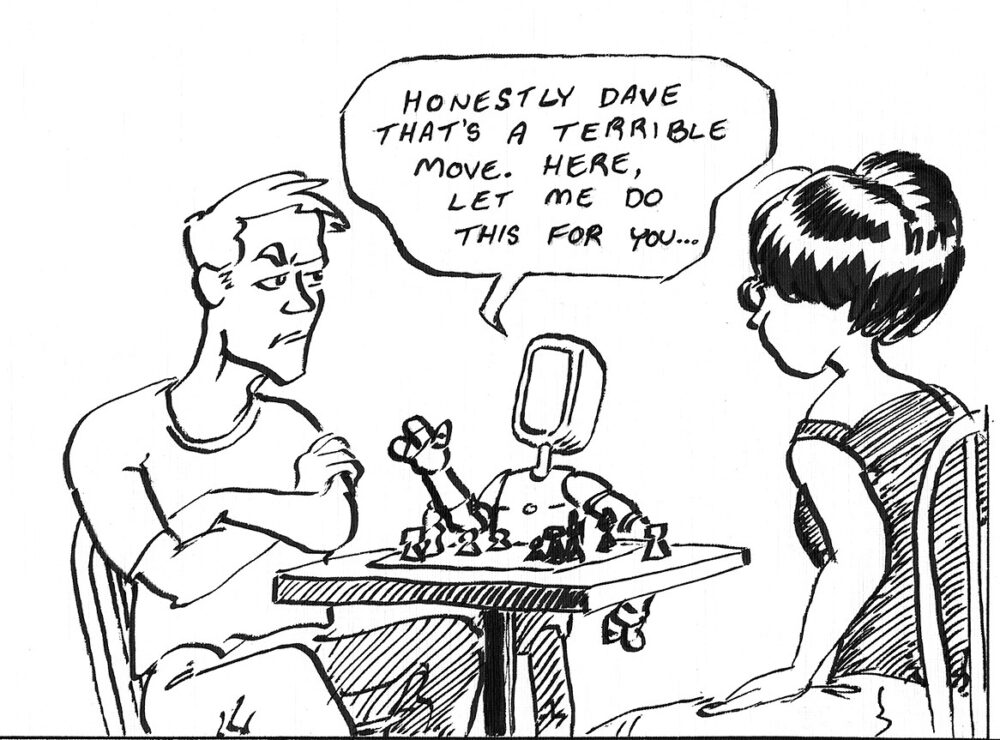
The risk of dehumanization
AI (Artificial Intelligence) is a new technology and all of us are grappling with the question of how to use it.
AI has moral and spiritual aspects as Pope Leo notes in his recent Encyclical Letter (Magnifica Humanitas, 102): “The use of AI is never a purely technical matter”. I think the Pope’s encyclical and Madonna House spirituality can help guide our consciences in using AI.
◈◈◈
AI Use in General
A big point of any technology is to use it as a tool. A tool refers to something made by human beings to serve some specific human purpose.
For example, a hammer is designed to push nails through wood. Morally, a tool should only be used insofar as it serves the ends we set for it. My preschool nephew has a hollow plastic toy hammer, but it fails at pushing nails through wood so should not be used as a real hammer.
We need not understand how a tool works to use it, but we need to remain focused on our goals, not letting it determine our goals. For example, few know exactly how a fridge or microwave work, but we can still use them as tools for our food. AI is often a black box like this where we don’t know exactly how it works.
In the whole of physical creation, only human beings are made in God’s image and likeness (Gn 1:28). Much of ethics is about living in accord with being in the image of God: I act in a way that is in accord with being made like God.
Cardinal Victor Fernandez distinguishes human and artificial intelligence in Antiqua et Nova (10 and 31): * “Our intelligence pertains to the totality of human person and mind, while artificial intelligence is just a function of many digitized steps, not a totality of the image of God. AI thus remains closed in on itself while human intelligence is open to the absolute.” This is a reminder that it is and must remain a tool. If it ceases to be a tool, technology enslaves us.
AI also carries the risk of dehumanization. Pope Leo mentions this in Magnifica Humanitas 10: “We must, then, avoid the… pretense that a single language — even a digital one — can translate everything, including the mystery of the person, into data and performance.
“The risk of dehumanization — of building a future that excludes God and reduces the other to a means — is an ancient and ever-new temptation that today takes on a technical guise.”
This is a danger where we reduce our unique personal humanity to a data point or set of numbers. Later, Leo XIV speaks of how the Incarnation reminds us that we are all embodied while AI seeks to transcend the limits of our physical body.
Pope Leo explains that AI cannot deal with ethics (par. 198): “Moral judgment cannot be reduced to calculation, for it involves conscience, personal responsibility, and the recognition of the other as a person.” Moral decisions often involve a great deal of calculation, but they cannot be reduced to that. AI can do the calculations but not the broader ethical work.
Such reflection precludes several uses of AI for Christians. We cannot use it for determining morals, for communicating with God, for uses where humanity is lost, or for setting goals. (It could break a larger goal into subgoals but can’t set broader goals.)
AI must be aligned with good human goals and used honestly, clearly identifying itself as AI. When these principles are followed, the use of AI is not intrinsically immoral.
Christians might use AI for text editing, for grammar and clarity, advanced searches (especially big data sets), summarizing texts, making personalized images (I gave my mom a Mother’s Day image with a cartoon of her, noting it was AI-generated), etc. We still need to check AI’s results since it can make things up.
◈◈◈
AI and MH Spirituality
The Nazareth spirituality of Madonna House and the Little Mandate* can give us some guidelines for evaluating the use of AI.
First, a big challenge in using a technology like AI is the loss of a sense of community. When the Amish explain why they don’t use a lot of modern technologies, they explain that their focus is on maintaining community.
Likewise, community life, expressed in Nazareth spirituality, is a key part of the Madonna House spirit. Such a spirit is built up over repeated small, personal interactions. Asking AI rather than asking another person is one less human interaction.
Secondly, technology can depersonalize us. There is something different about praying the rosary with a recording than praying it with a person. If I shop at a local store, I will likely say hello to people I know, but if I shop on Amazon, it does not matter who packs my order.
One line in the Little Mandate is “Give it directly, personally to the poor.” We do not just give 5% of our salary to Catholic Charities and call it a day. Personal involvement is a key part of the Madonna House spirit. It is a response to the depersonalized culture of North America.
Pope Leo proclaims in paragraph 114: “The quality of a civilization is measured not by the power of its means, but by the care it is able to offer, by its ability to recognize the other as a face, not merely as a function.”
AI tends to treat people as functions: AI knows my job and my online writing but it does not know me as a person.
A third consideration is the “slop” nature of AI which can tend to produce a standard set of images or texts that don’t really mean much. AI often imports data which can confirm one’s biases, even contrary to evidence. It can take the easy, quick route to producing content, which seems the opposite of doing little things exceedingly well for love of Jesus as expressed in the Little Mandate.
Fourth is the power of witness. Many people in North America today live without community, are depersonalized, and are used to fast, sloppy production over quality. Many even go beyond this, developing “relationships” with AI or allowing AI to run their lives.
When other people see someone who prefers to interact with people rather than with technology, they might realize, there is another way to live. Choosing to forego helpful technology for some greater good is a moment of witness to others. This aligns with the Little Mandate: “Preach the Gospel with your life — without compromise.”
Using technology less often can also be a witness. Students and parents at my community’s (Legionaries of Christ) schools are often impressed by the poverty of the chaplain who uses his six-year-old phone with a cracked screen rather than upgrading.
Hopefully, these reflections from Pope Leo and Madonna House spirituality will help us all use AI more mindfully (and, likely, less often).
◈◈◈
* Antiqua et nova (Latin for “Ancient and new”) is a doctrinal note of the Catholic Church co-issued by the Dicastery for the Doctrine of the Faith and the Dicastery for Culture and Education in January 2025. The document offers guidance for Catholic institutions and humanity as a whole regarding the ethical development and use of AI.
◈◈◈
** The Little Mandate
Arise – go! Sell all you possess.
Give it directly, personally to the poor.
Take up My cross (their cross) and follow Me, going to the poor, being poor, being one with them, one with Me.
Little – be always little! Be simple, poor, childlike.
Preach the Gospel with your life – without compromise!
Listen to the Spirit. He will lead you.
Do little things exceedingly well for love of Me.
Love…love…love, never counting the cost.
Go into the marketplace and stay with Me.
Pray, fast. Pray always, fast.
Be hidden. Be a light to your neighbor’s feet.
Go without fears into the depths of men’s hearts. I shall be with you.
Pray always. I will be your rest.
Sketch by ©Alexander MacAdam, Madonna House.