
No action, however small, is neutral.
Pope Leo’s first encyclical* arrived like an answered prayer.
For months I’ve been trying to organize my concerns about AI into a coherent argument, to no avail. As an educator, writer, friend, and member of the Body of Christ, I want to scream at the ways AI has been infiltrating our lives and capitalizing on our vulnerabilities.
“Maybe that’s what you need,” a friend said to me a couple weeks ago. “To scream.”
Maybe.
Probably.
In any case, the publication of Magnifica Humanitas has quelled the urge for now.
If you haven’t had a chance to read it yet, Pope Leo doesn’t condemn AI outright. Instead, he provides a framework for proper discernment about our personal and societal use of this technology.
He diagnoses the brokenness in society that AI exacerbates: the frenetic pace we’ve adopted, the worship of efficiency and production to the detriment of human beings, and overwhelming loneliness.
He also summarizes the history of Catholic social teaching in order to outline all the ways AI can and is being used to denigrate human dignity on both a personal and global scale, from widespread misinformation and rising unemployment rates to human trafficking, abuse, environmental disregard, and decisions about war.
The online world has been calling it a manifesto. Magnifica Humanitas is not simply a commentary on social ills; it’s a call to action and to a renewal of hope.
In arguably the most beautiful section of the encyclical, Pope Leo directs our attention to Our Lady of the Visitation as a model of Christian hope in action. He calls her Magnificat “the song of hope,” for it wells up in “a young, poor and humble girl” (243) * whose lowliness before God is the very source of her joy.
He reflects on the reality of her situation: “The Romans continue to control her land, and her people are still subjugated and humiliated. Yet, everything has changed within her, and this allows her to see what is invisible” (ibid.) It is the pure of heart, after all, who shall see God.
Like Mary, most of us are not among the elite and powerful. Our littleness on the global scale may give rise to “a subtle temptation […] namely the thought that the problems are too big and we are too small, and that our choices, therefore, cannot make a difference. This is a polite form of resignation, often disguised as realism” (212) *. (Or a growing impulse to scream).
Our Lady of the Visitation, on the other hand, models active Christian hope in an age of despair. Instead of giving in to the seeming inevitability of disorder, Our Lady shows us what happens if we dare to go deeper.
Her Magnificat directs our gaze to “the points at which humanity is broken and the world becomes distorted” […] teaching us “to look at the world from a lower position: through the eyes of those who suffer rather than the mighty; to view history through the eyes of the little ones, rather than through the perspective of the powerful; to interpret the events of history from the viewpoint of the widow, the orphan, the stranger, the wounded child, the exile and the fugitive.” (244) *
Herein lies our hope: God has already shown us that it is through the ordinary, humble, and overlooked that he saves the world. He stooped to the level of humanity and chose to live among the lowly as one who suffers. We, as followers of Christ, are called to do the same.
Instead of us placing “our hope in unlimited ‘upgrades,’ in forms of progress that exacerbate inequalities, and in immediate solutions incapable of healing people’s wounds,” (12) *
Our Lady’s hiddenness, and God hidden incarnate within her, are a call to reorder our priorities for the building up of the Kingdom of God. They remind us of our hope: that “in the humble fidelity of daily life, even the era of AI can become a time in which the Holy Spirit brings about the civilization of love in our lives” (245).*
I’m most familiar with this concept through the spirituality of Servant of God Catherine Doherty. She calls this “humble fidelity of daily life” the “duty of the moment:” the vocation of every Christian to do the little things that fill our days “exceedingly well for love of God.” She believes that this is how we will restore the world to Christ.
Pope Leo agrees: “No one is without responsibility […] The civilization of love will not arise from a single or spectacular gesture, but from the sum total of small and steadfast acts of fidelity that serve as a bulwark against dehumanization.” (212-3) *
No action, however small, is neutral. Our actions, words, and attitudes either contribute to the restoration of the Kingdom of God or to its degradation. Something as simple as washing the dishes, making the bed, giving someone our full attention, and speaking gently to ourselves and one another can help to heal a small corner of our world.
When it comes to technology, we need to prayerfully discern whether our use of these tools enhances or denigrates our own humanity and the humanity of others, and act accordingly.
In the age of AI, fragmented attention spans, and rising social injustice, it is easy to lose sight of the holiness of ordinary moments and private choices. But Mary of the Visitation shows us that God incarnate has broken into our broken humanity. Our menial days are thus filled with meaning, no matter how hidden.
More than six decades before the publication of Magnifica Humanitas, Catherine Doherty also saw Our Lady of the Visitation as a bearer of hidden Christian hope. On June 8, 1960, Catherine Doherty, Bishop Smith, and the Madonna House Apostolate gathered for the installation of the pilgrimage site of Our Lady of Combermere.
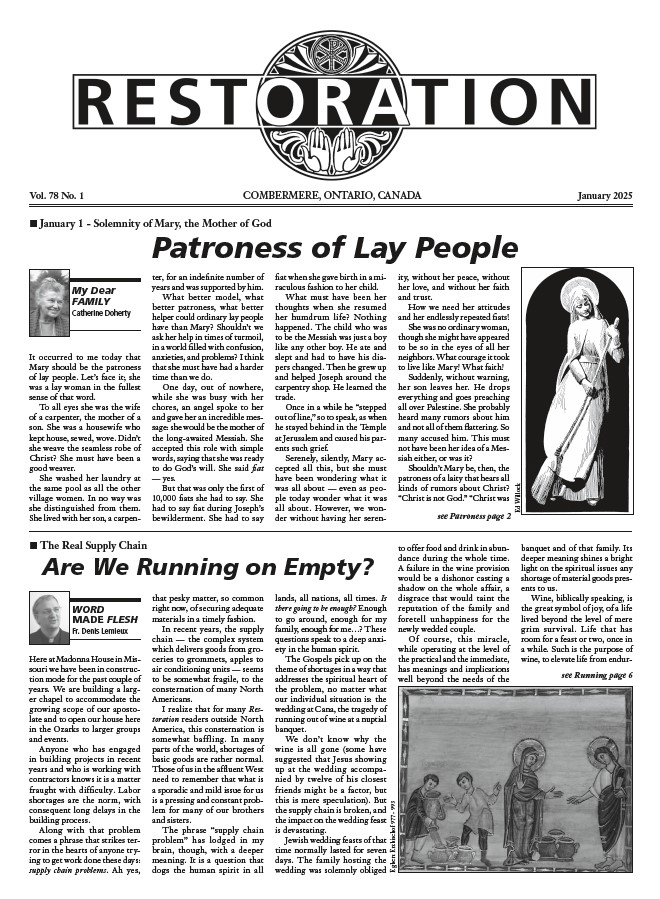
Also known as the Questing Madonna, she is the young woman of the Visitation, arms outstretched in greeting, veil fluttering in her haste. Our Lady of Combermere is literally hidden: concealed by cathedral pines, with lily of the valley growing on the forest floor at her feet. Our Lady’s hiddenness is integral to her message of hope, for she is the very place where the invisible God becomes visible, where majesty collides with littleness.
On the day of the installation, Bishop Smith said, “As the years go by, we seem to be living in a confused world which is becoming more confused all the time. It seems to me that the solution of the things troubling us today will be cared for by Our Lady.”
Magnifica Humanitas expands this statement of hope. Our Lady of the Visitation comes to each of us in her humility, arms outstretched, bearing God within her. Let us take her song of hope to heart and learn from her example, magnifying God to a broken world.
*Magnifica Humanitas – Encyclical Letter by Pope Leo XIV, May 15, 2026.
Mirjana, a friend of MH, writes a blog called The Littlest Pilgrim thelittlestpilgrim@substack.com
[image: StockCake AI-generated]