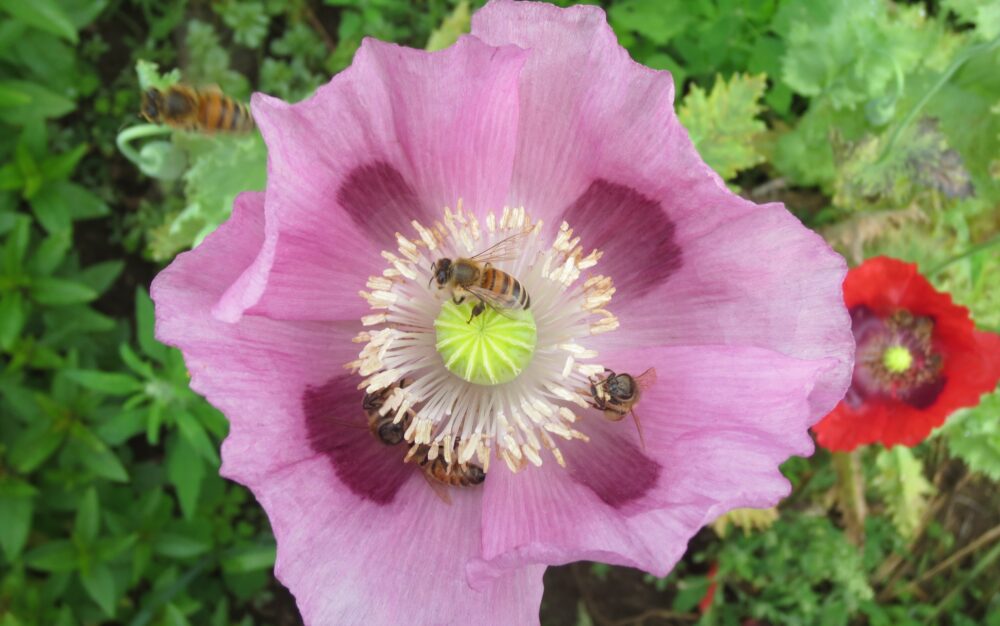
How lavish in his love is this God of ours, a spendthrift of love! Along with flowers, he fashioned many beautiful insects that take their food, their very life, from them.
Among them the virgin-bee reigns supreme. She transforms the flower nectar into honey which for thousands of years was man’s only sweet food and a health-giving food at that.
Out of the flower and her own body, the bee also fashions wax, which man has learned to use to bring light into his darkness. Not only factual light, but spiritual light — the beeswax candle burns on our altars as the symbol of the light of God, who is the Light of the world.
I was introduced to beekeeping long ago and far away by my mother. She was what beekeepers call a “peaceful woman,” meaning that she was not afraid of the bees, nor were the bees afraid of her. She brought them peace. They buzzed around her head, but they never stung her. The hive was made of straw.
To gather the bees, we tramped through the woods with a net at the end of a long, long stick, looking for wild bees. They were easily found in the hollows of tree trunks or in the tops of branches. My mother said that this was the time when one had to indeed be very peaceful.
After you caught the bees and shut them up in the hive, you watched them respectfully and with love, for no beekeeper could be without love. We believed that all living things needed loving gentleness.
We were very cognizant that we were somehow united to them and they to us. The Lord had given us jurisdiction over the earth, and this had to be exercised reverently, simply, and lovingly.
Beekeeping requires thought and prayer. You are, as it were, a shepherd of the bees. You can leave them alone, for bees are highly organized and know very well what to do on their own, but nevertheless, you also have to shepherd them.
You watch the hive, vigilant over the health and well-being of the buzzing “flock.” You especially watch the queen — her birth and growth, her nuptial flight. And watch for swarming, which is very important.
Watchfulness is a part of shepherding, and shepherding is a form of love. So the beekeeper who shepherds is loving. More importantly, he or she should be a person of prayer. Working with bees is an all-day job, especially if you have many hives. How is one to work alone without the support of prayer?
Factually, beekeepers are a kind of poustinik*. They do not spend half the week in prayer; no, they have a job to do. But in the silence of their work, a silence broken only by the buzzing of the bees, they have time to reflect, time to pray. They have time to be alone with God and time to observe the bounty and beauty of God in nature. They can become wise.
* Poustinik – one who inhabits temporarily or permanently a poustinia, a Russian word for desert, praying in silence ad solitude. Used here in a figurative sense.
From People of the Towel and Water, Madonna House Publications, 1991. A newer version of this book is available from MH Publications.
Photo by ©M. Victoria Fausto, Madonna House