Life can be one song of gladness, gratitude, and love for the Lord.
One, two, or more voices have come to me from various mission houses, asking for clarification about recreation. Most of you have already had the explanation of the word “recreation” itself. It means to renew or make new. That is the real, deep meaning of the word.
In ordinary language it means a change of occupation, not necessarily doing nothing, which is very boring. It definitely does not mean going to bed and sleeping. If someone stayed up all night, or if there was a late collective work bee, or if the apostolate demands tiring emergency work, then rest is indicated.
A nurse who has been up all night must be given 24 hours’ rest to recuperate. She will not be given 24 hours’ re-creation! Even our language does not gear us to such an interpretation of the word.
To recreate, then, does not mean to do nothing, to rest; it means to be engaged in an activity of re-creation. I want to be explicit and clear. You might be engaged in swimming and having a lot of fun. Recreating your spirit in that way is an activity. Then afterwards, lying in the sun, you might take a snooze for fifteen minutes, half an hour or so; or you might be reading a book quietly by yourself, recreating your mind, bringing it to new horizons and more creative understanding. That is okay too.
However, the best re-creation is togetherness. “A family who prays together stays together.” A family who recreates together, intelligently and lovingly, stays together. Doing things together makes us know and love each other more. Joy binds us, and laughter cements our relations. Knowledge gathered and shared with one another brings about a deeper union.
Creating, in the natural sense of the word, brings us closer together; devising a skit, planning well-known games, etc., helps us blend in spirit, in truth, and in fact. Thus, recreation can also become teamwork, even though it is “team play.” Teamwork and team play area must for good social intercourse. A good team play is a weapon of the apostolate.
Cricket Match
If your recreation includes, as it has and will, members of minority groups, or the poor, or any people you work with, a new spirit will develop; for people who play together can never hate each other. On this, incidentally, the British Empire was built — good, bad or indifferent though it may be. It was a force, British fair play and team play; and it fostered the virtues of justice, charity and, in ordinary language, fair play, sportsmanship, “playing cricket”.
All these natural expressions are really the reflection of the Ten Commandments applied to recreation and games. …Eventually you will get used to doing things together, and by doing them learn how much you grow in knowledge and love of one another, and then, in the perfectly natural order, how much fun it is. …
Do things together, and if you have read a book, share what you have read with others. If you have a snooze in a shady corner after swimming, join the others after the snooze. Togetherness is the foundation of recreation.
◈◈◈
God so loved mankind that he sent his only Son to redeem it. In his immense tenderness, he expresses that love in a thousand ways. But we sometimes have “eyes and see not, ears and hear not.”
When we do see and hear, we can gather up reflections of God’s beauty; a beauty so overwhelming, so joyous, so fulfilling, that life can be one song of gladness, gratitude, and love for the Lord.
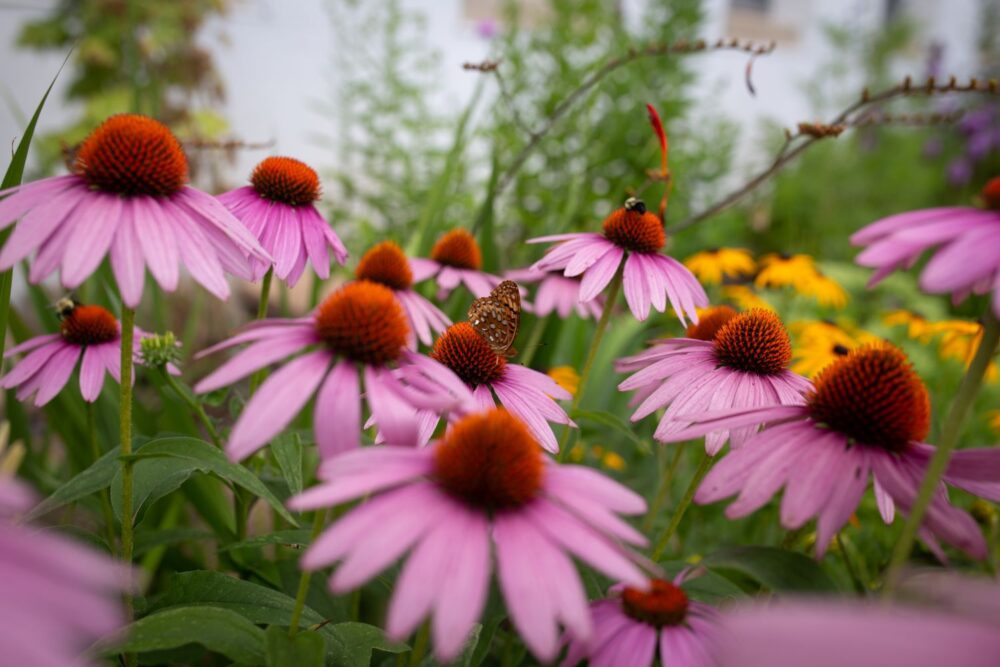
For example, take flowers — wild flowers, garden flowers. Look at each one separately. If you do, you can lose yourself completely in its infinite perfection. How gently, how tenderly, how compassionately he fashioned them to tell us, through their colors and shapes, of his love for us.
Vegetable gardens are like the corporal works of mercy. Apples, pears and other fruit, raspberries and other berries also belong to the corporal works of mercy. I think of them as beautiful things, but also as food and nutrition with their own spiritual lift.
But flowers! Flowers are spiritual works of mercy. If you are sad, go and look at a zinnia, orange and golden in the sun — a flower of hope. You cannot be sad when you look at a bunch of zinnias — it is impossible, especially in the sunshine!
Some of our gardeners used to say to me, “Flowers! Let’s get something that really gets into your stomach! A vegetable garden. Or fruit. But flowers?”
However, I think that flowers, the “useless” flowers that you cannot put into your stomach, are also needed. For if we think only of food, we shall forget that “not by bread alone does man live,” but also by the beauty that is the Lord. Flowers reflect God, and that is why I so love gardens.
And who is a flower gardener? A person who prays to God in beauty. A painter of the Lord. A musician of God. A poet of the Almighty. A person who makes beauty in the colors of flowers.
No one — atheist, communist, sinner, or saint — can pass a flower garden without stopping. In some places, raising flowers is an art almost beyond our understanding. A person’s soul, a nation’s soul, can be expressed in a garden.
Who is a flower gardener? An utterly dedicated person, who loves each flower tenderly and knows intimately the ways, habits, likes and dislikes of each one. He or she is someone who gives beauty to everyone — not ordinary beauty but God’s beauty. And if a gardener did not know God before he became interested in flowers, if he perseveres, he will know him soon, and know him intimately.
Who is a flower gardener? A person who sooner or later falls utterly in love with God, who approaches flowers reverently (you have to, otherwise they will not grow for you) and silently shouts his love of God. One who grows flowers gives God to man and becomes possessed by God himself.
Excerpted from a staff letter in June, 1958 and People of the Towel and Water, 2010, available from Madonna House Publications
Photo by ©Jenna Gernon