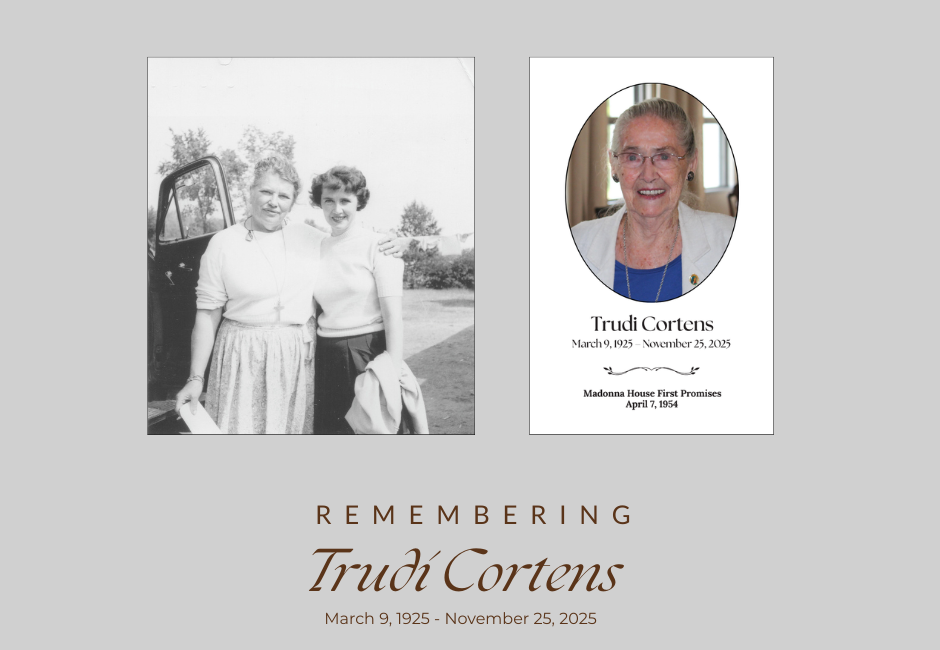
A long and faithful life.
“Trying to describe Trudi Cortens and her work is like attempting to explain a warm spring wind or a shooting star.”
This is the opening sentence of an article written about Trudi in a 1966 publication called Our Family. The author goes on to describe how Trudi and the Madonna House staff members brought love to the little island of Carriacou in the West Indies.
It wasn’t so much what they did, though they did perform many apostolic works and initiated multiple services to help those in need. Much of their work was achieved simply by their being the way they were, and by how they offered and received love from those around them.
It is difficult in a eulogy to do justice to someone like Trudi, who had 100 years to live out her unflagging zeal for the Church and her love of serving the poor.
My own connections with her were brief. I was in the West Indies in the early 80s for a time and then, 37 years later, I became the third director to serve in MH Toronto after Trudi. I must admit that it was with qualms that I took up the challenge of following in her footsteps in Toronto. I had the distinct impression that she had organized the entire city, and I knew she would be a hard act to follow.
So, I will start this evening with the fact that Trudi lived her faith profoundly and she had a great devotion to Our Lady.
On the back of her bedroom door are tacked her favorite prayers, various consecrations to Our Lady, the Divine Mercy chaplet prayers, a prayer to St. Joseph, and the memorial cards or photos of some of her loved ones: Fr. Duffy, Irene de Roche, Mary Davis, Kathleen Janet Thompson, Theresa Davis.
Just like the holy cards and prayers on her door, the small statue of Our Lady of Fatima, the large image of Divine Mercy or of the Holy Family which surrounded her physical space, Trudi’s life was encompassed by her faith.
She was born in St. Vital, Manitoba on March 9, 1925, one of eight children. Fourteen years later the family settled in Winnipeg. After high school, she worked for various firms, doing clerical, secretarial, and general office work.
In a letter of recommendation from the last of these companies, the manager wrote that she had “discharged all of her duties in a capable and efficient manner, exhibiting a greater than average intelligence and initiative. Her personality and characteristics are of a positive nature. She is cheerful, friendly, and cooperative.
“She has demonstrated marked leadership qualities and is respected by her business associates. We do not hesitate to recommend her most highly.”
Trudi joined the Victory Noll Missionaries where she received the habit and stayed for 14 months, a time which included more academic training. However, having discerned that this was not God’s plan for her, Trudi continued her vocation journey.
When a person joins Madonna House, we are asked to write out why we came here.
In her explanation of Why Did I Come to Madonna House? Trudi says:
That’s rather a ridiculous question to try and answer. Man proposes and God disposes. Sure, I can give you a few reasons why I came to Madonna House, but the real reason can only be given by the Lady of the House, our Blessed Mother, for she seems to have her own reasons for picking and choosing those she wants here.
However, Trudi does go on to explain that she had two weeks free, her annual vacation. She felt that rather than being selfish and going somewhere for rest and relaxation, she should probably stay at home to help out.
Her mother was tired, and she had brothers who needed regular meals. In addition, there was a good deal of cleaning, cooking, and washing to do while looking after eight visiting relatives.
She talked it over with friends, who pointed out that she had just finished an extremely busy year involved in too many things, including working with a young people’s club, helping with retreats, marriage courses, Marian days, night school, arranging a family wedding and too much responsibility at home. She did need a change and a rest.
She read the Friendship House pamphlet and the Madonna House Summer School prospectus. That attracted me a great deal, she said. I wanted to meet these people who literally lived the Gospel…(and whom the world thought were crazy) … and to see if this place really existed.
She decided to spend the first week in Chicago and the second week in Combermere. This would include a visit with her sister Lettie, who was coming for the MH Family Week.
It was just what the doctor ordered, Trudi thought: a little work, bed-making, dishes, gardening, but there was the pleasant anticipation of a good rest, swimming, hiking, and boating, as well as enjoying the talks about the restoration of the home to Christ.
She describes arriving on August 1, 1951 at 10:30 in the evening and sleeping on a bunk bed down at St. Joe’s. “After 36 hours of travelling, 7 a.m. rolled swiftly around, and I saw nothing adventurous or romantic about getting up looking like I had slept on a waffle iron.
The next morning, she met Catherine, who commented that she looked a bit “cityish”. After Mass and breakfast, she was put to work doing dishes and then cleaning and laundry. She thought to herself that she could have stayed home and done all that. That’s when she discovered the summer school was only for married couples, and she wouldn’t be attending after all.
She goes on: “Well, I decided the work wouldn’t kill me, and I should stay around and visit with my sister for a couple of days.” In the meantime, she hoped to grasp a little of the spirit of love, joy, and peace which permeated this outstanding group and take it away with her. She realized that this spirit was the result of serving others.
She ends with: “As I watched this love in action, the desire to join these crazy fools of Divine Love grew in me, and with my decision to stay, my holidays gradually turned into “holy days.”
Trudi became an applicant the following January and made her first promises in April 1954.
Catherine Doherty soon recognized Trudi’s excellent organizational skills. She worked as Catherine’s assistant for several years, and then, as Madonna House developed its Constitution, she became the first Local Director of MH in 1958.
Catherine was grateful for the help. She wrote that Trudi “has taken a great burden off my shoulders, allowing me these weeks to sort out historical data, which I have to do for the future of the Apostolate. Due to her, the archives that will be vital to future generations will soon be in complete order.”
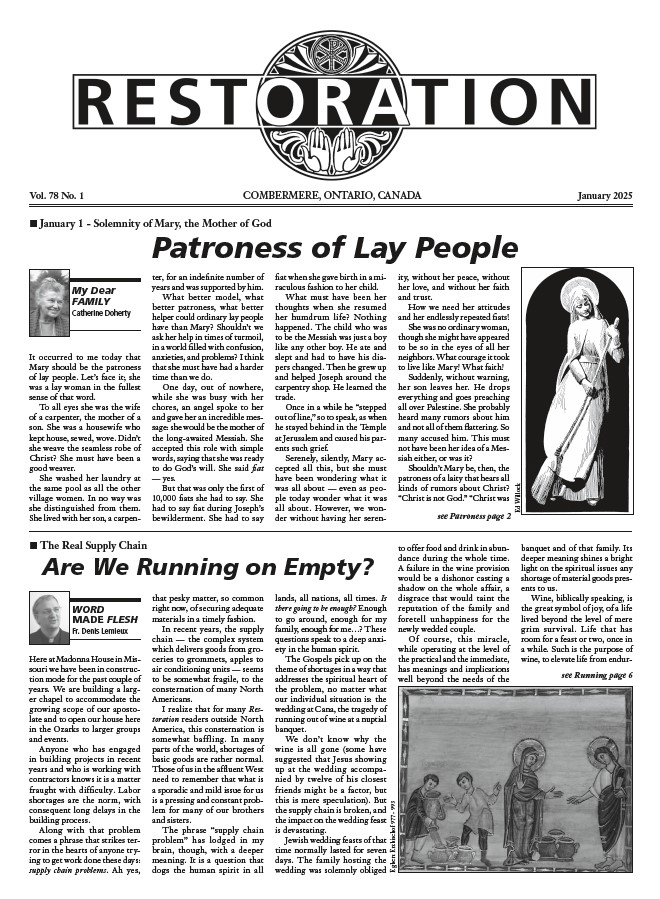
In a Restoration article in 1994, Trudi wrote about that period of her life: “The most precious and treasured years of my MH life are those between August 1953 and May 1961. This was the time I lived in Combermere and worked so closely with Catherine Doherty … or “the B” as I prefer to call her.
“The formation I received during that period was worth twenty university degrees. B knew something about everything, and her hunger to pass on knowledge knew no bounds! I love to learn, so I was glad for the privilege of working so closely with her during those unique years when our MH community was so small.”
As is true for many of the pioneer members of MH, who took a risk when they joined this fledgling community, Trudi had a number of “firsts” to her credit. When the St. Joseph’s Rural Apostolate became a separate mission serving the local people, Trudi was named its first Local Director in 1959.
She recalls the admiration she felt for the sacrifices many families made over the long winters in this rural area, when the men went to the lumber camps, leaving the women to look after the children, do the basic farm work and keep the house supplied with wood for heating.
She tells the story of a mother of a large family with few of this world’s goods. “She said to me one day, ‘I am not poor. You are only poor when you want something you don’t have. I don’t need anything.’ As someone with a promise of poverty, I have never forgotten her words.”
In 1961 she was asked to take on the responsibility of founding and developing our first overseas mission, in Carriacou, West Indies, where she served for two decades.
She loved it there, both the place and the people. In 1977 she wrote: “I love Carriacou. I am constantly awed by the fact that God has allowed me to live here for nearly 17 years, and I want to drink in all the beauty.
“Mostly I am aware that being so close to so much beauty means being very close to God. His presence seems so tangible that it literally takes my breath away. I realize how good God has been to me — the peace, the tranquility, the luxury of so much beauty. The gorgeous flowers. The beautiful people here — gentle, loving, kind, healing — are always instruments of grace.”
Sister Trudi, as they called her there, was considered the mother of many people in Carriacou. She took on anybody and everybody.
Here is another quote from that time which is vintage Trudi: “I rejoice that I don’t need a lot of sleep — the days, weeks, and months literally fly by — and I want to be awake for every moment that I possibly can.”
During several sabbatical periods over the years, for rest and recuperation, she took a photography course, set up a dark room at Madonna House, worked at Cana Colony, and was housemother at St. Germaine’s, among other tasks.
In 1982, after a time of renewal and recuperation, Trudi was asked to open a new Madonna House in Toronto at the invitation of Cardinal Carter, returning to where Catherine had started her apostolic work over 50 years previously. The 30-plus years she spent there as director were her last field assignment.
In 2017 Trudi returned to St. Mary’s in Combermere, and despite slowly declining health, over the next eight years she continued to take an active interest in every person and every event.
Four days before Trudi’s death, our applicants (novices) went to Our Lady of the Visitation to visit with the family there. Trudi carried on an animated conversation with Caroline, who was astounded at the level of interest Trudi showed in her. “She wanted to know everything. Where I was from, how the church is in that part of the country, what is happening there, etc., etc.”
In each of her field assignments, it was characteristic of Trudi to assess the needs of the people and then to respond with new initiatives. Like our foundress, Catherine Doherty, she seemed driven by the needs she saw around her.
She was involved in establishing craft co-operatives, food banks, educational programs, Red Cross stations, and a myriad of other services to help those in need.
It goes without saying that Trudi could not have accomplished all that she did without the support of a dedicated and self-sacrificing team of staff members. It is not easy to live in the vortex of someone as energetic and zealous as Trudi.
Throughout the years in Toronto, Marie Javora, Irene de Roche, Elaine Dalton, Josephine Halfman, Philomena Lim, Carol Ann Gieske, Fr. Duffy, and others poured themselves out selflessly to bring to fruition the works of the apostolate directed by Trudi.
I remember visiting the house in Toronto while Trudi was director. It seemed there were several activities going on at once and that this was normal. But her busyness did not prevent Trudi from hearing a cry of anguish.
One night a lady called in distress and was considering suicide. Trudi immediately roused almost the entire household to go with her to befriend this lady. The friendship established that night endured for years.
Trudi noticed things. She was at Mass one day at St. Joan of Arc parish, just around the corner from our Toronto house, when she noticed a group of Chinese people. After Mass she went to meet them. She discovered they were new in Toronto and were looking for a parish and friends.
She took them all home with her for breakfast, and that was the beginning of years of deep friendship, a Chinese prayer group, and relationships that endure to this day.
Another person, a new Local Director, was having a difficult time one year during one of the Directors’ Meetings. Trudi noticed this and took her out for a hamburger. “In the middle of lunch, Trudi said to her, “If you ever need me for anything, just call me.”
What makes a person successful or even great in Madonna House terms?
Testimonials from Trudi’s 100 birthday celebration earlier this year give us a clue:
One person wrote: “You have been an example to me that it is possible to live a long and faithful life and not lose your unique spark of curiosity and interest in what is happening in the world.”
Someone else wrote: “You have been a true anchor of faith in my life, providing stability and hope in some of the most difficult times of my life. Your sharp mind, wisdom, and experience have helped untold numbers of people.”
Our own Bishop Brehl wrote: “Trudi, your life has been a true pilgrimage of hope and a journey of faith. Beginning in Manitoba with your birth, baptism, and confirmation, this pilgrimage brought you to Madonna House and first promises over 70 years ago.
In obedient love, you have served in Combermere, the West Indies, and Toronto. …You have balanced prayer and presence, rest and work, always mindful of your consecration to God and service to the Church – and especially to the least sister and brother.”
Trudi was filled with zeal for God’s work and she kept her eyes on the goal:
I will end with Trudi’s words from the early days in Carriacou: “Our one prayer is that we will be able to meet the spiritual challenge that is before us…the words, ‘the fields are ripe’ have never seemed more true.”
Eulogy given at Trudi’s wake service, December 1, 2025.