We are all the poor ones of God
It is a scene of devastation, love and hope. A scene from the movie, The Soloist, which somehow reveals the stunning beauty and tenderness of the heart of God.
Based on a true story, the film depicts a Los Angeles Times journalist, Steve Lopez, who wants to understand a new friend, a homeless man who is a musician and who suffers from mental anguish.
When Lopez first encounters Nathaniel, he is playing Beethoven on a violin with only two strings. Nathaniel is wrapped in the passion of the music, playing to the pigeons who clap their appreciation with their wings and soar with the music to the heavens.
Wanting to give his friend a place of safety, Steve finds an apartment for him, but Nathaniel prefers to sleep on the street. Why? Wanting to understand, Steve searches skid row one night to find Nathaniel, and it is frightening — drug dealers are menacing, pimps and prostitutes dart out of the darkness, violence suddenly flares up in different corners.
When he finally spots Nathaniel, they bunk down in a door way, with cardboard for a bed. As they settle in the darkness of night, Nathaniel begins to pray the Our Father.
Tender music accompanies his prayer, and the overhead camera offers a sweep of this motley, destitute, and beloved swath of humanity: some people are trying to sleep, others are shooting up, others are gratefully eating a meal provided by good Samaritans. There are sporadic flashes of violence and frustration, but for the most part, these poor souls are trying to survive.
With great confidence, Nathaniel says, “I think these children of God are going to be ok. I hope the whole world rests well.” He then prays the familiar words. He doesn’t doubt that the Father is there with them all. And as the camera sweeps over the scene, it feels like the Father’s gaze on his people, loving each one with great tenderness.
It is a vivid image of the Father’s love for all his children, perhaps poured out most powerfully on the poorest.
When I was a young woman, I backpacked through many countries, ending up in India. There, in a leper colony at the edge of a Christian ashram, I met my Nathaniel. He was a young man disfigured with the disease, isolated in this seemingly God-forsaken corner, cut off from outside contact except for weekly Masses offered by the resident priest.
This man was radiant with love and gratitude. He lived in destitution, but he knew himself to be loved by God, and that was enough. I felt blessed by the presence of Christ in him.
That’s where my eyes were first opened to the presence of God in his beloved poor, and I have sought him there ever since.
I have lived in Toronto for several years now, and have encountered different kinds of poverty. Just around the corner from where we live is Bloor St., where many of the homeless stake out their corners.
For the most part, they are open to some kind of relationship with us. We learn their names, we share short conversations, sometimes we offer a sandwich. Occasionally it seems that someone is falling through the cracks, and we see what connections we can make for them.
We notice when they’re not around. We grieve some of the indignities they suffer, like Jeremy no longer being able to find shelter in the warm library, because the teenagers swarm him during the noon hour.
The more hard-core poverty is seen downtown, where the effects of drug abuse and mental illness are more ravaging. But if you live or serve in this area and come to know the names and stories of the street denizens, your heart can break with their suffering and beauty.
In this area, what’s staked out is not a corner, but a grate where heat rises from the subway labyrinth. One man sleeps on a particular grate right on a street corner, forcing people to walk around him. He has a sleeping bag, but when it is sleeting, it does little good. It feels like a crime to leave him there, but apparently, he will not move.
Poverty through mental health issues is searing, and difficult to assuage or even to touch. Some days it feels like we have a constant stream of people suffering from addictions, compulsions, gut-wrenching grief and loneliness, begging for consolation and finding precious little. But for them, it is enough to have a listening, sympathetic ear — to have someone truly look at them and see their heart.
The only time I’ve touched evil was on a city bus, travelling to an area of the city I hadn’t visited before. A nicely dressed man with a brief case got on the bus, engaged in a phone call. He continued his conversation in a loud voice, spewing toxicity on all of us as he discussed what his customers wanted in his women — body parts were described, with no sense of a person inhabiting the body.
It was shocking and vile, and no one knew how to stop it. We got off the bus shortly after, and as we passed a few men sitting on the pavement, we heard them almost casually talking about a comrade who had been beaten within an inch of his life on that corner the night before, and probably wouldn’t survive.
The only prayer I could muster that day was Lord have mercy. They know not what they do.
Another kind of poverty we encounter is in our friendship with refugee families. We can help initially with some money or making connections with different agencies. But so often, the help dries up after they have received their refugee status and find a place to live.
They now live in a free country but cannot really afford rent in this expensive city, or the funds to move to another part of the country that’s cheaper. Usually only one parent can find work, while the other cares for the children, and this meagre salary is not enough for Toronto costs.
Their dream of living in safety with their children has threats they never envisaged. And yet, I have to say I’ve been humbled by the faith and resilience of these friends.
I haven’t mentioned the poverty that needs no trip to skid row to be revealed — the interior poverty in our families and in our own hearts. We all suffer from fears and brokenness and doubt. We all feel helpless in the face of the implosion of our world.
We all find ourselves struggling to love and forgive at times. And God’s response is always the same: an outpouring of tenderness and a plea for us to receive his love and mercy.
Of course, I could go on and on, but I return now to the scene from The Soloist. Human eyes and hearts often condemn what they see in the visible poor — partly out of fear and wanting to be defended against such misery. But God knows the story behind each person — the abuse, the poverty they were born into, the debilitating hold of addictions or mental illness that is choking the beauty of the person.
Our heavenly Father sees his sons and daughters and longs only to rescue them, and he never stops his efforts of grace to penetrate the prison bars. His benediction and love and call is continually being poured over his beloved poor.
Nathaniel was aware of God’s presence, and that was enough. He didn’t ask that all the suffering be taken away, but he called upon God’s blessing on his fellow street dwellers.
Steve Lopez initially wanted to help this poor man, but he gradually recognized the dignity and greatness of his friend and that his attempts to “help” just got in the way. What ended up being enriching for both of them was love.
We do need to see poverty and need around us and to help as we can. But more than this, we need to recognize that we are all the poor ones of God, all in need of friendship and respect. We can lavish that on one another, receive it from perhaps unlikely sources, and touch the heart of God in our midst.
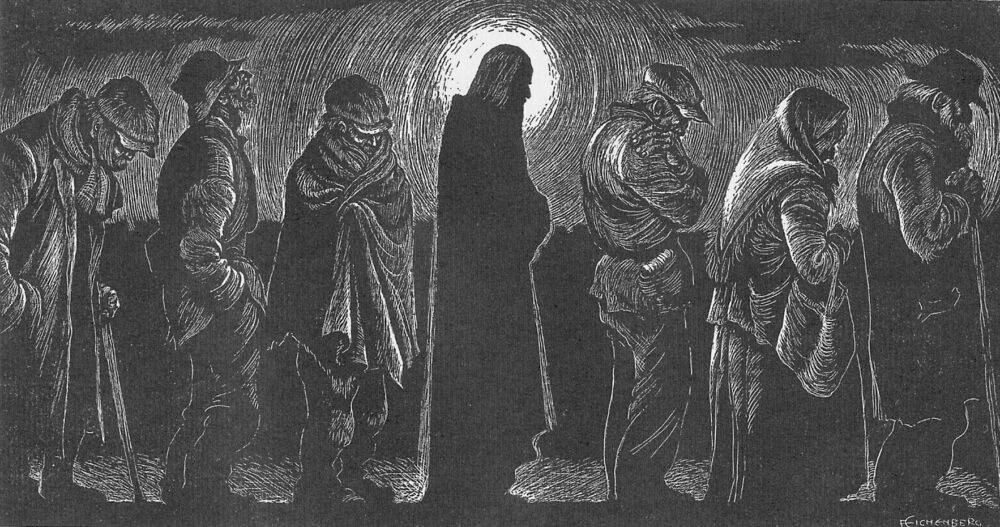
[Christ of the Breadline, woodcutting by Fritz Eichenberg]