Editor’s note: As part of ongoing formation at MH, Fr. Denis taught a class on the Mass, which we will present in three articles.
◈◈◈
The subject of this class is the basic structure of the Sunday Mass in the Roman rite, the ordinary form of the Eucharistic celebration. Why we do what we do when we “do Church” together. Why is the Mass the way it is?
I have three quotes from Catherine Doherty about the centrality of the liturgy in our lives.
“It is time that we began to nourish our souls on the meat of the saints. Because, when all is said and done, our greatest school of love is the liturgy. Our days are spent between two Masses, and when we think of time, we should have no other time but that. Our tomorrows are God’s, and our yesterdays are his, and our todays are rooted in the morning Mass and flower in the Mass of the following day.
“And we pray that the fruit of these Masses, day by day, 24 hours by 24 hours, will be heaven where our living with Christ, now in faith, and in the Mass directly, will be completed in his marvelous light.” (From a 1956 staff letter.)
Here is one of Catherine’s core teachings from a 1961 staff letter: “Liturgy and scripture are the life of the soul. Without them, it would die. They do not form, as it were, a separate apostolate but become the woof and warp of the apostolate lived anywhere — in married life, in monasteries, or in cloisters.”
This third quote, from 1962, is from a staff letter occasioned by a series of talks on the liturgy by one of our priests. When he told Catherine that the staff seemed bored, she made inquiries. It turned out that the staff all had a perfectly good head knowledge of the liturgy. They could talk about the sanctoral cycle and the seasonal cycle, and they knew all the parts of the Mass. But it didn’t mean anything. It was just words.
“When I heard this,” Catherine wrote, “I couldn’t believe my ears. …If I have stressed anything in my life, it has always been that the liturgy, and especially the Mass, is the very center of our life.
We have two columns on which Madonna House Apostolate rests, from which it gets its spirit and its very life: Scripture and liturgy. …You’ve got to steep yourself in the Mass. Learn about it, pray about it. For unless you do, your life in Christ will have no deep roots, no deep spiritual roots.”
These are strong words, meant to be taken very seriously. Unless you enter the liturgy, your life will have no deep spiritual roots.
We have to be careful that we don’t develop an approach to the Mass that reduces it to a sort of functional purpose. We can easily fall into a way of thinking about the liturgy in which everything is just the preliminaries, a series of actions to get us to what really matters — receiving Communion.
An appreciation of the liturgy is an appreciation of every moment and every movement of the Mass. To know that every moment of the liturgy, when we enter deeply into it and we understand it, is so charged with meaning that it nearly stands on its own, at least as a subject for meditation and contemplation.
A very basic principle of liturgical theology and spirituality is that when we enter into liturgy, we are fundamentally entering into a prayer that is not primarily or even secondarily our own prayer. Liturgy is not essentially personal prayer.
You can, and should, pray at the liturgy. You should pray while you’re washing the dishes and splitting wood, too. We should always be praying. But the fundamental reality of liturgy is that we are entering into the prayer of Christ and the prayer of the Church.
It is the prayer of Christ to his Father, offering himself in loving obedience as a sacrifice of praise for the salvation of the world. It is entering together as the one Body of Christ into the prayer of Christ in a corporate, communal fashion.
This is why the liturgy has a rather rich, rigidly defined structure, why we are called to practice liturgical obedience. We cannot simply do whatever we please in the liturgy; we can’t shape and change the rites of the Mass to something that seems more relevant or more enjoyable. There are very limited, very carefully circumscribed moments in the Mass where there is a little room for adaptation, but they are quite minimal.
The first reason is that when we make changes in the liturgy, we’re quite prone to introducing things that are just plain wrong, or heretical, or silly — that’s just our poor, frail humanity.
But this is not the most important reason. Far more important is that the structured, ordered, mandated organization of the Mass signifies that the moment we enter into sacred liturgy, we are journeying out of our own personal prayer, out of our own personal spiritual life and whatever is preoccupying us at this moment, into a reality that is not ours properly but of which we are invited to become part.
Liturgical structure and discipline are an invitation to a sort of spiritual exodus, to come out of our own personal subjectivity into communion with Christ and his Church in a common act of worship.
Some of us remember an era in the Church of great liturgical “creativity,” shall we say, where all sorts of things were being changed around, and you never quite knew what was going to happen at Mass! If our liturgical formation was in that loose ambiance, then the current move in the Church to simply being obedient to the words and the instructions given in the Missal is in the exact opposite direction.
For those of that earlier generation, this might seem constricting or like a collapse into legalism. However, it is neither tight nor constricting once you understand that liturgical discipline is a pathway out of ourselves and into the prayer of the Church, united to the prayer of Christ which, of course, is rooted in the life of the Trinity. It’s anything but constricting. In fact, it is the ultimate liberation that in submitting to the discipline of the liturgy, we are entering ultimately into a sharing in the very life of the Father, the Son, and the Holy Spirit.
◈◈◈
Now let us take a gentle walk through the Mass from the beginning to the end of the Liturgy of the Word.
It’s worth noting that the fundamental structure, which is shared among all the rites of the Church, has not substantially changed since the earliest records we have, which are from the immediate post-apostolic era.
Justin Martyr, who is from the second century, gives a description of the Eucharistic ceremony that he was familiar with, and it is structurally the same as our current Liturgy of Word, Liturgy of Offering, Liturgy of Eucharist, Liturgy of Communion. This implies that there is something in this core liturgical structure which is so true to the heart of worship that we really cannot change it and still be doing Christian worship.
The Mass begins with a procession. The priest, the servers, and in some contexts the reader proceed from the back of the church to the front, or some such processional route. They proceed from the sacristy to the sanctuary. Now, this might seem like a mere matter of practicality, but there’s nothing in liturgy that is strictly utilitarian.
This entrance procession — and every procession in the liturgy — signifies the exodus that I mentioned earlier. The liturgy is first and foremost a pilgrimage, a movement not so much from one place to another but from one mode of existence to another. From earth to heaven, from nature to grace, from man to God. And the entrance procession, with its pomp and ceremony, music, and candles, communicates that we are on the move together.
The ceremony involved signifies that it is a beautiful reality. We are being led into this new mode of being by Christ our Lord through his Cross. So, on this exodus we are led by a cross, accompanied by some form of proclamation in words, either an entrance antiphon, a psalm with a refrain, or a hymn.
The antiphons are proper parts of the Mass. They’re just as proper to the Mass as the opening prayer, the first reading, and the preface. During the 1970s, after the Second Vatican Council, they were lost, sort of by a historical accident. Now there is a movement to restore them to their proper place.
But whatever form of antiphon or hymnody is used, the underlying point is to signify, in movement and word, that we are stepping into the realm of liturgical prayer, not individual prayer. We’re leaving behind our own words in order to take onto our lips and into our hearts the word of God.
The priest reaches the front and venerates the altar. Christ the priest venerates the altar, which is both the symbol of the priest and also the symbol of the Cross. It is a sign of devotion and love for what is about to happen.
Next comes the sign of the cross and the ritual greeting. The entrance rites serve to bring us together into an assembly, a body, the Church, which is itself a manifestation of the presence of Christ: “Where two or three are gathered in my name, I am there in their midst.”
But we have to be gathered rightly, and what gathers us rightly is the sign of the cross. We mark our very bodies with this sign that communicates God’s love: the death of Jesus, his saving action, the reality of the Trinity, all marking our whole body with this together.
And then the ritual greeting, which in its fullest form is, “The grace of our Lord Jesus Christ, the love of God, and the fellowship of the Holy Spirit be with you.” It is God given to us in Christ and his work of redemption that makes us one body, one people.
So, this little opening ritual and dialogue in the first five seconds of the Mass immediately calls us to arise, go, and enter into the heights and the depths of what we are doing. We are plunging together as a body, in our bodies, into the life of the Trinity made available to us in the action of Jesus Christ.
After being drawn together into one body by these opening rituals, we acknowledge together our sins. We are entering into an objective reality, communion with God in Christ and therefore into communion with one another.
That is why we have to acknowledge any and all failures to live that communion since the last time we came to Mass — we have not gone forth in peace glorifying the Lord with our lives, we have not announced the gospel of Christ, we have not lived in his peace.
So we have to say, “I’m sorry, pray for me. Lord, have mercy. Christ, have mercy. Lord, have mercy.” Because the reality we are entering into is the most awesome, sacred, and truly transcendent reality, we must enter it with deep and profound humility of heart.
But there is constant movement, and now our focus shifts again from us to God, and we have the ecstatic hymn of the Gloria, acknowledging that despite our sins, God is, in this liturgy, making us into a body in which he himself is present. Knowing that our God is merciful and forgives our sins, the most normal, natural thing in the world is to praise him and thank him and bless him and adore him for his great glory.
The entrance rites conclude with the Collect, so called because it collects our individual prayers together into one. Here, we experience another element of liturgy which is very important: the feast, the season.
Liturgy, besides being a fundamental movement from self to communion, is also a movement through time and space, a movement that carries us through the year. And so, the Church at various points in the liturgy focuses on one aspect or another of the mystery of the faith through the seasons and feasts of the year. The Collect is one key place where this seasonal focus is highlighted.
Then we enter the Liturgy of the Word. We have encountered the presence of Christ as he brings us together as the assembly. Now we are to encounter the presence of Christ as his Word is proclaimed to us.
It’s important to recognize a certain vital dynamic here: how the liturgy consists of a constant exchange between God and us in which we bring to God our goods (which we only have because he gives them to us), and then he gives us his goods. We give to God and he gives to us, in a constant flow, back and forth, all in the context of everything being given by God because we are his creatures.
In this, we see the reflection of the very life of the Trinity where the Father and the Son live in an eternal exchange of being and love. The Father begets the Son, which means the Father gives all that he is as Father to bring forth the Son. The Son’s Sonship consists in that he receives all the Father is, and his Sonship, his reception, is so complete that he in turn gives all that he is to the Father.
The Greek word is perichoresis. This constant movement back and forth, love and gift, and the love is so perfect that it contains the fullness of the Godhead and is the Holy Spirit.
Our “goods” in this first movement have been our choice to come together as a body, to express our sorrow for our sins, to sing our praise and thanksgiving to God, and to pray together as a body led by the priest. All of that has fashioned us, by God’s grace, into a sacred assembly, a gathering for and with the Lord. And now God reciprocates, and he teaches us his word, his truth.
…to be continued
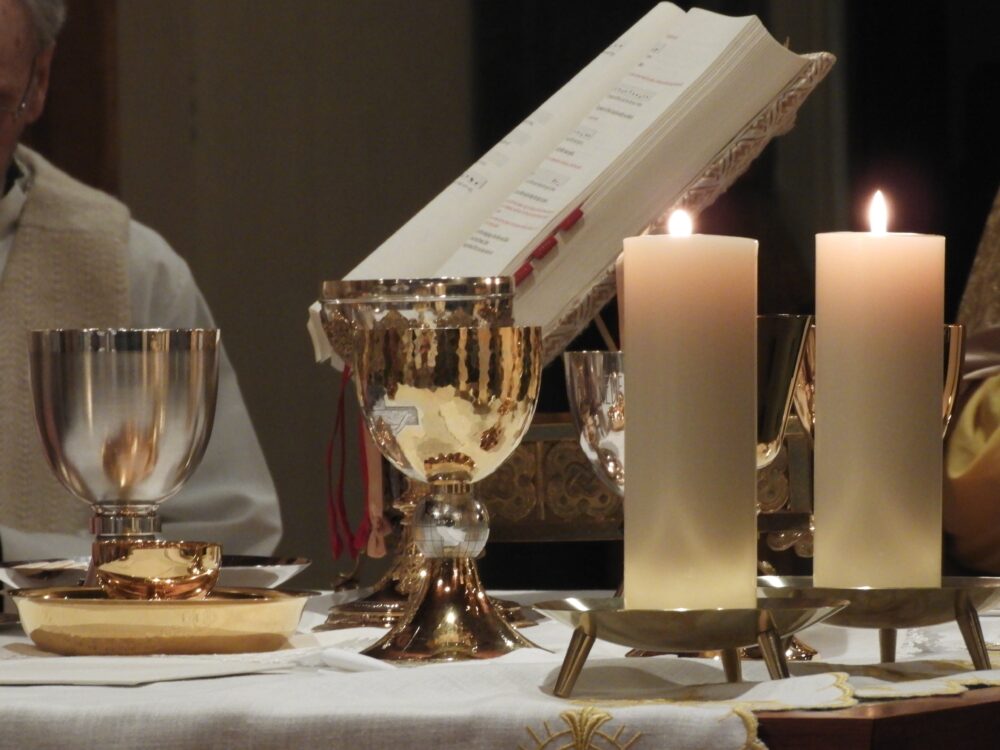
[image: St. Mary’s Altar by ©Beth Scott, Madonna House]