Living in the risen Presence.
The Holy Spirit is seeking to make the truths of our faith more a part of our normal daily consciousness: truths such as the indwelling Trinity, that we are kept in existence at every moment by a God of love, that we are destined for everlasting life, and many others. However, the main mission of the Holy Spirit is to make Jesus Christ come alive, especially in his resurrection from the dead.
Thus, my theme in this meditation is that there is one truth that should grow in our consciousness more than the others. At first thought, this may sound like a misguided idea. Are not all the great truths of the faith of equal importance? Yes and no. I emphasize that there is one truth that should have precedence over all the others in our awareness—the Resurrection.
The Resurrection is the central mystery of our faith. “If Christ is not risen,” says St. Paul, “you are still in your sins. But Christ is risen. …” St. John Paul II said that if Christ had not risen from the dead, there would be no reason to believe anything he said. Other people have lived holy lives, performed miracles, preached some marvelous truths—but no one has ever risen from the dead before. The tomb of Christ is the only empty tomb in the world, visited by millions of people.
Therefore, the truth that the Holy Spirit is, above all, seeking to bring to our consciousness is that the risen Lord is now present to us at every moment of our lives; indeed, present in us. To expand on this, I want to draw you into two experiences I had in the Holy Land that helped to make the Resurrection central for me.
Priests can sign up to celebrate Mass in Jerusalem at the Church of the Holy Sepulchre, which surrounds Christ’s burial tomb. In this Church there is also a fairly large Catholic chapel. One morning, after vesting at 5:30 a.m., I started walking towards this Catholic chapel, but the attendant motioned me to follow him. We started walking towards the actual tomb of Christ! I could hardly believe it: “I’m going to celebrate Mass in the tomb of Christ!” And that’s exactly what happened. They had set up an altar right on top of Christ’s tomb, and that’s where I celebrated Mass. Only several nuns were present. I was totally discombobulated, but I think I said all the prayers validly.
Since places are holy because God has acted there in a special way, the places of Christ’s resurrection appearances have an exceptional holiness. And the place on earth where Christ actually rose from the dead—the empty tomb— takes precedence over all other visitations of the Lord.
That morning was when I realized that the Resurrection was the central mystery of our faith. If you believe that Jesus rose from the dead, you are a Christian; if you don’t believe this, you are not a Christian. This place where I celebrated Mass is the holiest place on the planet earth because here the Trinity performed the great, defining act of the new creation—the resurrection of Christ.
The second experience I want to draw you into happened on the shore of the Lake of Galilee, where the Lord prepared breakfast for his friends. The Franciscan fathers have a residence and chapel on that site, and I stayed with them for three days. I used to get up at night and spend an hour or more just sitting on the shore and mediating on this gospel scene. The sky was an explosion of stars, and the silence was palpable.
My pervasive experience at these nightly vigils was like a return to paradise. His suffering was over, and the Lord was here in his risen presence, preparing breakfast for his friends. He no longer was asking, as in the garden of Eden after the fall, “Where are you?” He was having a meal with his new friends. The stars and the silence added to this paradisiacal atmosphere.
This gospel story presents a rather unique visitation of the Lord—it is quite prolonged, more than any other. Most of his other experiences we know about are rather brief and almost instantaneous: he appears, says a few words, and then disappears. But during this visit on the seashore, he took time to prepare a breakfast, eat with his apostles, and socialize.
And then we have the long conversation with Peter. I once saw a painting where Christ and Peter were sitting on a log during this visit. Christ had his arm around Peter’s shoulder, sort of consoling him. No doubt Peter was still smarting from his denial. Maybe Christ spoke briefly with each of the apostles as well. He didn’t seem to be in any hurry.
Christ’s visit on the beach lasted for quite some time. It was here that I received the grace to understand that now the Christian life essentially consists of living each moment in the presence of the risen Lord. These episodes of the post-Resurrection visits are the most important stories in the history of the world, and they are our stories. We can’t mediate on them too often.
I have often wondered, why didn’t Christ appear to the important people of the world—the kings and the Roman senate, for example? Wouldn’t his message have spread faster and been a better PR program?
But these are human thoughts from our modern world of communications. By acting in this way, he would have conveyed the message that he was interested mostly in the important people of the world. That’s not how he spent his time with us when on earth. He spent his time with ordinary folk.
So, after his resurrection, he appears to Mary Magdalen and the women, to friends walking along the road, to his apostles while they are fishing. We don’t know who else he appeared to—probably his mother.
The Gospel does not contain all the events of his life (as St. John tells us, 21:25), and probably not all his resurrection appearances were recorded either. But he certainly didn’t appear to Caesar Augustus.
One of the most important truths of our faith, therefore, which the Holy Spirit is trying to make more of our normal, waking consciousness, is the constant presence of the risen Lord at every moment of our lives. The essence of Christian existence is living in this risen Presence.
Years ago, there was a woman guest at Madonna House who was really looking forward to Easter. But Easter came and went, and nothing much happened to her.
Then, a few days later, she rushed up to me quite excited: “Father Bob, Father Bob!” I said, “Something has happened.” “Yes,” she said, “Jesus came to me at the back sink!” That was her Easter. Doing dishes at the back sink, she had some wonderful experience of the Risen Lord.
From an unpublished manuscript, Word at Journey’s End.
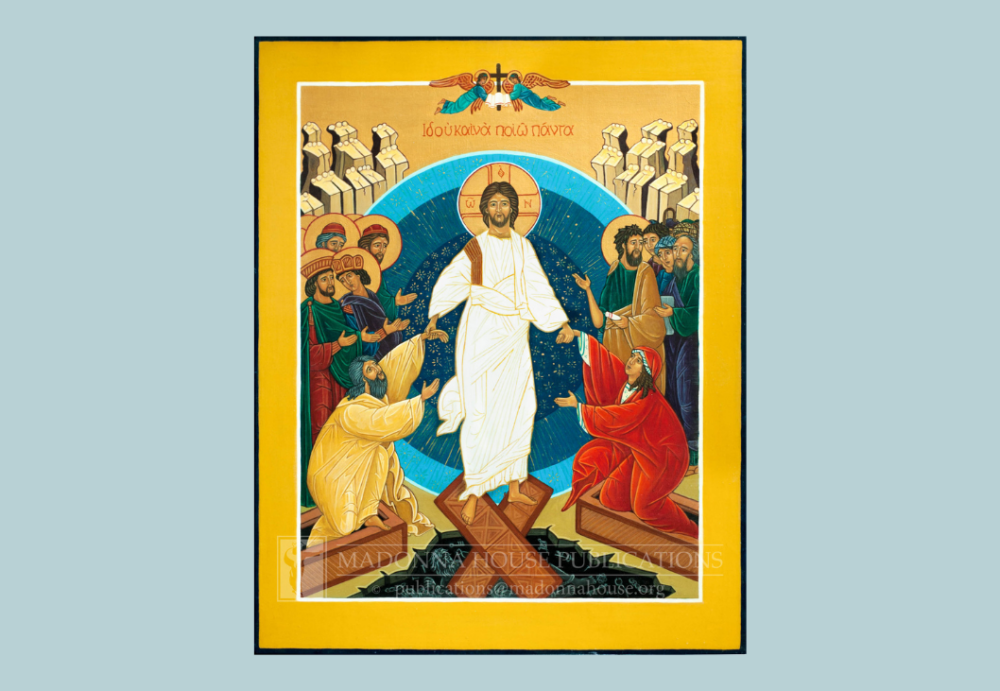
[Icon of the Descent into Hades, by ©Helen Hodson, Madonna House.]