Pain became my salvation.
On my 80th birthday, someone asked me, “What helped you most in life?” Spontaneously and surprisingly even to myself, I blurted out, “suffering.” I meant it in the sense of Although he was Son, he learned to obey through suffering (Heb 5:9).
By God’s grace, through suffering I have learned that there are physical laws, and also psychological and spiritual ones, which must be obeyed if one wants to lead a healthy physical, emotional, and spiritual life.
A Smoker
For example, I used to be a heavy smoker, so much so that my physician warned me when I was 52 that I had about five more years to live. Giving up smoking was not easy, but the pain paid off, and gradually I began to feel the benefits.
I lost my hacking cough, I could walk for more than half a mile before becoming breathless, and my lungs gradually repaired themselves. Plus, I became free of that nagging need for making sure that I always had a good supply of cigarettes on hand.
And, although so many men in my family have died of emphysema or throat cancer, I do not have either disease.
For years, though, the desire to smoke remained so strong that I never trusted myself even to light another person’s cigarette.
Then there’s food. At Madonna House, since we changed our diet, it is probably the healthiest in the world. But many of us find this “health food” diet difficult. I did too for quite a while, but now, thank God, I am most grateful for it, for our nurses report a decrease in illness among us since that change.
Another area in which pain became my salvation was through the disappointments, failures, and rejections in many interpersonal relationships. One day God finally enlightened my mind, and I saw that what was wrong was my attitude.
I was trying, to rephrase the words of the Prayer of St. Francis, “not to console but to be consoled.” That is, in my relationships I had been attempting to fulfill my own emotional needs. It’s true that nobody can live without love, but when I stopped looking for it, I realized how much I was getting.
Saved
Many times I’ve been helpless before my pain and frustrated, angered, disappointed, disillusioned, or depressed by it. But what a joy to discover that it is through helplessness that one is saved from terrible arrogance, pride, and self-sufficiency, and from being hard and demanding on other people.
Gradually I learned to turn to God and to Our Lady, to cry out to them, and to wait patiently for their action and response which, by the way, never fails to come.
And I also learned that though God always answers prayers, he doesn’t always do it in the way we want. Sometimes he has a much better plan in mind. So often what we ask for would only increase our selfishness. By denying us, he heals us of a greater illness and draws us much more closely to himself.
What has helped me the most in life? Perhaps not pain, but the acceptance of pain,—the acceptance of God’s ways rather than my own.
Seeing how beneficial the acceptance of suffering is, I now pray to rejoice and praise God for saving me by saying “no.” Now I even pray that pain for me will be what it was for Catherine Doherty—the kiss of Christ.
When someone hurts you, I believe there are three steps to joy: 1) to stand still in the pain without even trying to make sense of it 2) as we become calmer, to accept it 3) to praise God for it because it brings us much closer to him.
The Perfect “Yes”
The life of Jesus and the life of Mary reveal this profoundly to us. Yes, Our Lady is the icon of the perfect fiat, that perfect “yes” to God—yes to his plans, to reality, to his love which is so different from our concept of love. When pain comes my way, I still scream, I still seek ways out.
But when I am helpless, I ask Our Lady to obtain for me the insights necessary to accept it all as a blessing from God, for myself and for others.
I ask her for the grace to say fiat each day, each moment, so as to fit into God’s plans until my last breath. And I do this fully aware that by myself I cannot stand the least pinprick.
Adapted from an unpublished manuscript (approximately 1997).
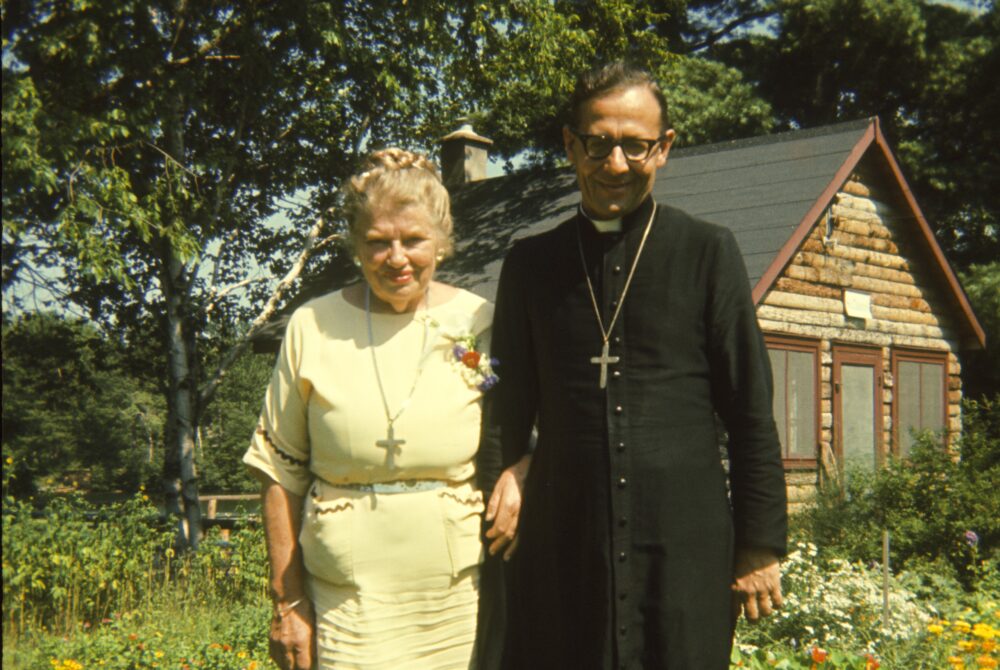
[Photo: Fr. Emile-Marie Brière with Catherine Doherty in 1965.]