We listen in the depths of our hearts
Silence belongs to the realm of the unknown. It is in the realm of hearing God’s voice. It is in many ways like the darkness of night. It is a mysterious place which we become aware of only by adjusting our senses. I want to share two experiences of silence and then, with the help of some spiritual authors, talk about what silence is.
I recently experienced this darkness of silence during a one-day retreat. I had stopped at Madonna House’s Marian Acres in Missouri while moving across the USA to teach at a different seminary. One of my days there was dedicated to poustinia, a cabin set apart where a person stays for 24 hours.
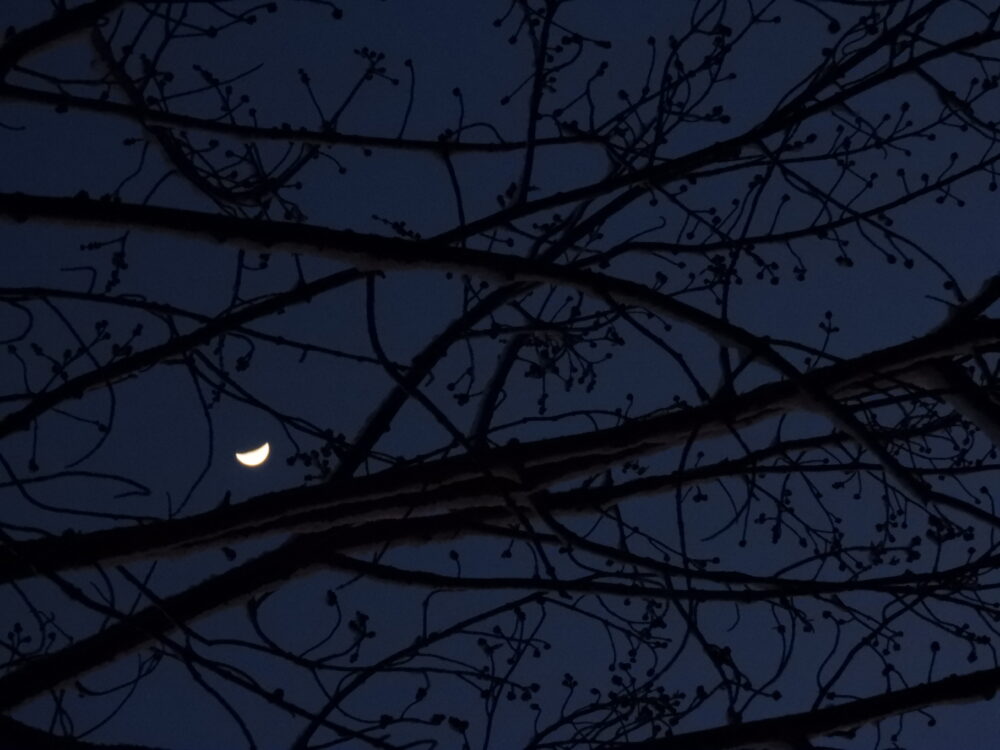
That evening after sunset, and while the sky was overcast, I turned off the lights and stepped onto the porch. At first, I could see nothing, but as my eyes adjusted to the darkness, I could make out the trees just off the porch. Each time I briefly switched the lights on and off, my eyes had to adjust to the darkness.
This reminded me of the silence of the poustinia. As I first go into this silent space, God’s voice is not immediately evident, but as I remain in that silence over a period of hours, I can hear his voice. It comes slowly, not all at once, just as the trees slowly became visible on the porch. Because of my determination to stay there in the darkness or silence, what is in front of me— whether the trees or God’s voice — becomes evident.
A few weeks later, I had the opposite experience. I set my phone and laptop aside in the corner of a room to do a similar poustinia day of silent retreat in my own house. (I am a religious living in community, but we each have our own room.)
Despite my intention to not check them all day, I slipped and checked my messages on various apps a few times. I am weak. Such distractions still have a pull on my heart. Even though these distractions were only a small portion of the day, I heard much less of God’s voice.
These two examples have taught me that silence in prayer is not so much a matter of not talking, as of focusing on God alone. I can say my prayers out loud and still be in silence, but I cannot check messages on the phone, and worry about all the little things to do, and still be in silence.
It is not the repetition of the Jesus prayer that breaks silence but my sister’s message of some cute thing my nephew did, or some plans for future events which the community is texting about, or the replies to my online posts.
Being a somewhat pragmatic and practical person, I have found that whenever I try to have extended silence, I will always somehow start to remember things I need to do soon — that item I forgot to pick up at Walmart last week or the person I need to email about an event in two weeks.
I always need to take a piece of paper with me on such prayer days in order to write things down, so that they won’t take away from the silence. Like the single flick of a light switch breaks the darkness of the night, a single practical issue like that can take away from silence.
We usually see silence as an absence in our society. It is an absence of noise. However, when the spiritual authors speak of silence, they mean something active.
Catherine Doherty states, “True silence is the search of man for God.” Everyone seeks something divine —in the marketplace, in pleasure, in self-importance, but silence opens our hearts and minds, much better than any of these, to see what true divinity is.
Sr. Marie Paul Curly, a Catholic religious sister and spiritual author, explains, “Silence usually makes us more aware of our feelings, which is important if we want to be fully present to our own lives.” We need to be fully present to hear God’s voice. That presence requires self-awareness.
Part of silence is that self-acceptance where I am sufficiently OK with who I am to enter the silence. We are all sinners, but we are redeemed sinners. Deep silence does not require perfect knowledge but accepting ourselves to the degree we don’t instantly break the silence by our self-criticism.
Pope Francis spoke of silence as a way to hear what God wants of us: “In that silence, we can discern, in the light of the Spirit, the paths of holiness to which the Lord is calling us” (Gaudete et Exsultate, 150). When we truly hear God’s voice, he directs us to where he wants us, be it to preach or to be a contemplative.
In these three authors, we see Sr. Curly explaining the self-awareness that brings us into silence, Catherine denoting the moment of divine encounter as the center of silence, and Pope Francis talking about the result of that encounter.
Catherine also notes, “Silence is sometimes the absence of speech — but it is always the act of listening.” What distinguishes spiritual silence is not that there is no noise, but that we listen in the depths of our hearts.
This listening usually cannot happen in the bustle of a busy street or shopping mall, but it would not be unusual for some to find such silence in a prayer service where people are singing or reciting prayers.
At this point, the attentive reader may note that I have spoken of silence as darkness, but that is not fully accurate. It is much more like the blinding light I experienced when I went from the dimly-lit halls of my elementary school out for recess on a snow-covered playground, the sun beaming down in a clear sky.
As in the darkness, I can’t immediately see things clearly, and I need to wait for my body to adjust. But in this case, the blindness comes from the over-abundance of light, not its absence. God is always speaking, but our weak human senses and our fallen human heart are not adjusted to his words. They are above and beyond us.
The difficulty of living in silence is pretty universally recognized. Thomas Merton, a monk and spiritual writer, testified to the Church’s tradition, indicating, “The trials of the contemplative life are much more difficult to cope with than those of the active life.”
It is easier to operate in the world of noise and action where there is always something to do than in the world of contemplation and silence which invites us just to be. Although being is more central to who we are as humans, it is often more difficult to accomplish. Simply being in silence requires a focus that is beyond what is needed in the midst of noise.
Silence challenges us — to walk into the light, to initially be blinded but to eventually adapt to what God has to say, to just be with God. However, its rewards far exceed its challenges. Silence transforms us and helps us to be the Christians we are really called to be.
Few are called to perpetual silence as hermits or Carthusians, but all of us need times of silence. These times cannot just be mere minutes but need to stretch into longer periods. My own monthly day of silence may be too much for many, but it is good to fit in at least a few hours with some regularity. This longer silence allows us to become more adapted to God’s voice, more attentive to it, and better able to respond.
Fr. Matthew Schneider, LC is a friend of Madonna House and teaches at Holy Apostles Seminary.
[Photo: Tree branch silhouette in night sky by ©Beth Scott.]